Recently, I wrote about the concept of self-loathing among immigrants. My thesis was that some immigrants want so badly to be considered “American” that they will join in on hatred aimed at newcomers.
As we know, all immigrants are not Hispanic, nor are all Hispanics immigrants. However, it’s safe to say that immigration and Latino culture are closely linked. Therefore, you will be delighted to know that self-hatred can transcend citizenship status and careen right into questions of ethnicity and race.
For example, a few weeks ago, the GOP candidate for governor in Nevada, Brian Sandoval, endeared himself to his fellow Latinos during an interview with Univision.
Just to be clear, nobody should yell “Nazi” at people unless there are, you know, actual Nazis present.
I make this clarification not just because it’s the truth, but because so many people have had their sensibilities offended during the arduous debate over immigration.
Judging from reader comments to several of my posts, it is not illegal immigrants and their supporters who have been slandered. No, this coalition of liberals and minimum-wage workers — outnumbered by at least two to one in many opinion polls — are the aggressors.
Yes, the “Nazi” label has apparently been tossed at people who support laws such as SB 1070. Now, even if you’re in a privileged position of economic power and numerical supremacy, and the person yelling it is near society’s bottom rung, that’s got to sting (although it would be nice to acknowledge that dynamic).
For the sake of argument, let’s call it even, and forget about all the racial slurs and threatening vitriol aimed at illegal immigrants. We’ll also let it go that much of people’s defensiveness (“I am not a fascist!”) is just the attempt to counter-attack uncomfortable accusations of racism.
It’s impossible to measure how many individuals on each side are acting like lunatics and to what degree. So let’s just call it unsightly all around.
However, I would ask that if you send me hyperbolic emails detailing crazed behavior by illegal immigrants, as one person did, that you at least keep it timely.
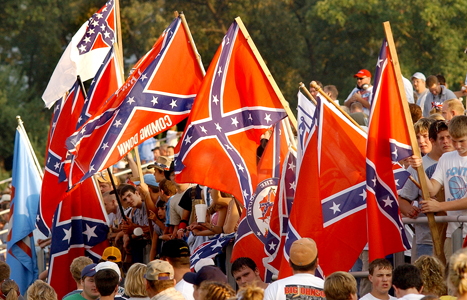
You see, I recently received a forward about the Montebello flag-raising incident. If you don’t recall, some Latino teenagers in California got out of hand during a demonstration. They raised the Mexican flag, and hung the American flag beneath it, upside-down.
It’s certainly a striking image. Perhaps that’s why it’s still flying around the internet as proof of a Latino insurrection, despite the fact that it happened in 2006.
Now, it would seem to me that if nothing more egregious than raising a flag has happened in the last four years, then the Hispanic overthrow of our government is not quite the threat the right wing is presenting.
At the risk of becoming defensive myself, I’d like to bring up an image from a demonstration that resonated with me. Granted, the protest was about healthcare, not immigration, but it at least occurred within the last year or so.
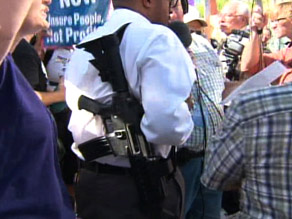
You may have seen this gentleman, and others like him. They believed it was a good idea to carry assault rifles to venues where President Obama was speaking.
The response from conservatives was praise and the usual pontificating about Second Amendment rights.
So if we’re keeping track: A bunch of unruly teenagers come up with a tacky way to protest, and it becomes a horrifying sign of revolution. However, grown men show up with firearms in a clear attempt to terrify their political foes, and it is a sign of patriotism.
The kids were disciplined for their idiotic prank. The guys with guns, however, went about their lives just fine, with the biggest burden probably the hassle of digging through the fan mail they received.
I could also point out that many of those teens have been told, sometimes overtly, that they are subhumans who have no rights. This is contrast to the adults with guns, who tend to be at the top of the American pecking order. They should also be – and let me phrase this delicately – old enough to know better.
So by all means, if the emotional response of teenagers is more of a threat to you than the aggressive tactics of adults, make your case. The odds are, however, that you will lose that competition.
When I was a kid, my mom volunteered to get the ERA passed. She was disappointed (actually, quite pissed) when the Equal Rights Amendment ran out of gas near the finish line.
The ERA was fairly popular, but it couldn’t get past the high hurdle that proposed Constitutional amendments face: Two-thirds of both chambers of Congress must pass it, and then three-fourths of the states have to approve it. There’s an alternative method of approving amendments that involves a Constitutional convention, but that route is less common.
In recent months, we’ve heard that another change to the Constitution is imminent. Yes, conservatives have their hearts set on revoking Amendment 14. This pesky amendment, among other things, establishes that people born in the United States are full citizens.
When President Lyndon Johnson signed civil rights legislation in the 1960s, he famously remarked that Democrats had lost the South for a generation. Of course, he was an optimist. It’s two generations, and counting, since white Southerners have become synonymous with the Republican Party.
Over the years, I’ve received readers’ comments that range from astute to insane. The thoughtful, the witty, the shrill, and the easily offended have all sent me missives. Both praise and damnation have hit my inbox.
However, only a few comments have prompted me to write a whole post in reply. That short list just got lengthened.
On this Independence Day, let’s acknowledge a truly patriotic viewpoint. Yes, regardless of our political orientation or cultural viewpoint, we can all agree on one thing: most Americans are stupid.
People on the left think that of people on the right, people on the right think it of people on the left, and we all have disdain for the wimps in the middle. Because most people don’t agree with us on a given subject, they are stupid.
Of course, if we really think about it, it could not possibly be true that a majority of our fellow citizens are mouth-breathing neo-Neanderthals. But even the most kind-hearted among us has, at one point or another, bemoaned the inability of the thick-headed masses to comprehend our opinion.
The exception to this rule is when we find, to our surprise and joy and even alarm, that the majority concurs with us. Then we’re quick to say, “Hey, most people agree with me, so back off.”
The fact that we so easily fluctuate between praising and rejecting other people’s opinions should tell us something. But all it really does is entrench our positions. I’m as guilty of this as anyone.
The reason I bring all this up is because that infamous tool of totalitarianism – the public-opinion poll – shows that more Americans support Arizona’s new anti-immigration law than oppose it. In Arizona itself, the law is popular with an overwhelming 70 percent of the population.
Well, that should do it then. The law stands. The debate is over. We live in a country of majority rule, after all.
There’s just one problem: We don’t vote on rights.
Either Arizona’s law is unconstitutional or it’s not (frontrunners for its eventual overturning are the Fourth and Sixth Amendments). In either case, it’s not left to a popularity contest.
The truth is that America is more about minority rights than majority rule. I know I tread on dangerous ground when I invoke “the Founders,” but I will do so now. The framers of the Constitution were pretty damned touchy about the tyranny of the majority. That’s why they came up with that pesky Bill of Rights.
As such, we can’t just deny rights to groups we dislike, be they Latinos, gays, or Nickleback fans (actually, that last one may pass Constitutional muster). This concept seems difficult for Americans to understand. So let’s go with a historical example.
No doubt, in 1950, most Americans would have voted against letting black people enjoy the privileges that the majority culture enjoyed. Change came about not only because people got educated and the younger generation took control, but because of things like Brown vs. Board of Education. The Supreme Court, in what can only be called an activist decision, said that basic rights are not dependent upon the generosity of the majority.
Again, we don’t vote on rights.
But setting aside that basic concept, let’s look at the reliability and immutability of public opinion itself. Remember that on the eve of the Iraq War, polls showed that upwards of 80 percent of Americans supported George W. Bush’s policy of “regime change.” Somehow, I doubt that decision garners this kind of enthusiasm today.
That was way back in 2003. What will Americans of, say, 2017 think of our opinion?
I’m not big on symbolic acts. For example, candlelight vigils, no matter how noble the cause, tend to annoy me. And when I was Catholic, I could never figure out how abstaining from meat on Fridays was anything other than a mild gesture that was unlikely to appease an omnipotent being.
So when I heard about the Dream Walkers, I was dubious. Now I certainly didn’t doubt their sincerity and courage, but I questioned whether their strategy would lead to anything meaningful.
The Dream Walkers, in case you don’t know, are four Latino college students from Florida who pledged to walk the fifteen hundred miles from Miami to Washington DC in order to raise awareness for the Dream Act (see my previous post on this). The students also want the government to step up on immigration reform.
Besides getting them some exercise, I wasn’t sure this interstate marathon was going to be too productive. However, the students have thus far completed their trek to DC, met with Valerie Jarret (one of President Obama’s top advisors), garnered publicity and conducted multiple interviews to educate people about the Dream Act, and even coaxed a hug out of Sherriff Joe Arpaio. That last one freaks me out.
Currently, the Dream Walkers are on stage two of their campaign. They are travelling to immigrant communities, where they will document the horrors of our messed-up immigration system. They will collect testimonials about botched deportation procedures and terrifying raids, then return to Washington DC to present their findings.
I don’t know where the students will end up, or how long they will be on the road. I also don’t know what the result of all their hard work will be.
But so far, the four of them have accomplished a hell of a lot more than even the largest candlelight vigil.
I’m hoping that my fellow blogger Macon D doesn’t sue me, but he had such an interesting post recently that I’m just going to steal his topic outright and run with it.
At his site, Stuff White People Do, Macon D asks if many whites believe that improvements for ethnic minorities come only at their expense.
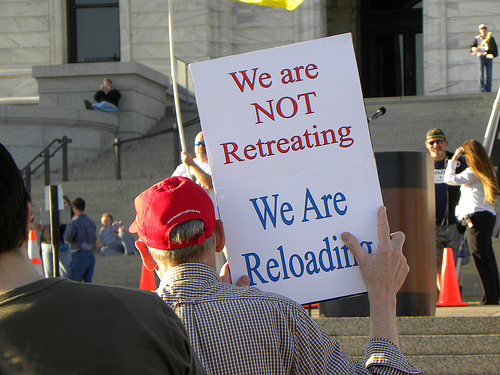
Well, as a partial answer, let me say that as far as I can tell, America is the only country in the world where the most economically powerful take to the streets to protest that they are being oppressed.
Thanks, as always, to Macon D and Ankhesen Mie for their support. And thanks to all of you who checked out my new gig at Change.org (although, as Ankhesen can attest to, there is more serious crazy among readers of that site than I assumed there would be).
In any case, let’s talk about our favorite people: the architects of Arizona’s anti-immigration law.
The law’s backers believed that their get-tough approach to illegal immigration would garner them nationwide praise and respect. Indeed, many states have proposed enacting a similar version of the law, proof of its effectiveness at riling up conservatives.
However, the law’s supporters must have thought that the only individuals who would object were illegal immigrants themselves and a few bleeding hearts. That hasn’t been the case.
First, the initial public outcry has already been effective in changing the most odious portion of the law. Under the revision, police cannot stop people for the sole reason of questioning their immigration status (in theory at least). The fact that the law’s backers thought everybody would be fine with a cop frisking people at random shows how invincible they believed their position to be.
However, that revision hasn’t prevented further protest. We’ve seen tens of thousands gather from Los Angeles to New York to demonstrate against the law.
More important, talk of boycotting Arizona and/or its corporations has intensified and cannot be dismissed as empty threats. About thirty organizations, and untold thousands of individuals, have pledged to avoid the state. In addition, more than twenty conventions, conferences, and meetings have relocated out of Arizona because of the law.
To get that many people to flee the area, one usually has to announce something truly horrific, like “We start filming Battlefield Earth 2 here tomorrow.” But all that it’s taken is one misguided law.
Recently, St. Paul jumped to the front of what might prove to be a long line of cities banning official travel to the state of Arizona.” Those crazy lefty towns of Los Angeles and San Francisco have also decided to skip sending anyone to Arizona for the foreseeable future.
The cities of Tucson and Flagstaff won’t be on that list (considering its rather difficult to boycott their own state) but their respective city councils plan to sue to get the law changed. Elsewhere in Arizona, people are starting to worry that Major League Baseball will pull the 2011 All-Star Game from Phoenix, as pressure increases on MLB to hold the game somewhere else. Commissioner Bud Selig has insisted that the game will take place in Arizona.
But speaking of the sports world, the Phoenix Suns recently played some games in jerseys altered to read Los Suns to, as player Amare Stoudemire put it, “let the Latin community know that we’re behind them 100 percent.”
Multiple MVP Steve Nash has endorsed the idea, as has former basketball great Charles Barkley. In fact, Barkley says that pro sports teams should actively boycott Arizona (and he lives there).
The funny thing is that Barkley is a well-known Republican. In rethinking his allegence to conservatives, Barkley is not alone. Apparently, even some Republicans don’t think the law is such a great idea.
This feeling is especially strong among conservative Latinos “who have become an increasingly important Republican constituency in a number of Southwestern states [and] are considering bucking their party.” It’s as if Republicans actively wanted to drive Latinos out of the GOP, and thereby verify the allegation that they care only about the well-being of Southern white people.
To be sure, most Americans – and certainly most Arizonians – favor the law. But if the law’s backers thought that only meek objections would greet their decision, they were seriously mistaken.
When you’ve managed to anger the country’s largest minority group, entire municipalities, members of your own political party, and a major sports franchise, you’ve really underestimated the opposition.
Never mind, I’ll just move on to my main point, which is that I have never understood the deep mistrust of the U.S. Census. I’ve written about this before.
Apparently, a noticeable segment of the population is terrified that filing out this form will allow the government to stick them in internment camps, Christopher Lambert style (and yes, displaying a clip from “Fortress” is officially the most obscure pop culture reference to date on this site):
In any case, it seems that right-wing nuts aren’t the only ones who believe the Census is all a plot… a slow-moving, bureaucratic, cumbersome, and tedious plot, but a dastardly scheme nonetheless.
According to the Pew Hispanic Center, just 57 percent of native-born Latinos believe that census participation is good for their community. This means a large number of Hispanics distrust, or at least dislike, the Constitutionally mandated exercise.
Strangely enough, it is foreign-born Latinos, many of whom may not even be citizens, who are more accepting of the process. The Pew Hispanic Center says 80 percent of them believe the Census is a good idea, adding that “the foreign born are also more likely to correctly say that the census cannot be used to determine who is in the country legally [and] more likely to trust the Census Bureau to keep their personal information confidential” than Latinos born in America.
Once again, this proves that assimilation is definitely taking place. Just as foreign-born Latinos tend to get obese and unhealthy the longer they live in the United States, so are their offspring more likely to turn into government-hating paranoids who can’t be bothered with facts. So to everyone who says Hispanics can’t assimilate – in your face!
But aside from the inherent hatred that the Census provokes, there is also the messy racial element on the form itself. As many people have pointed out, the form does not list Hispanics as a race. Instead, we are an ethnicity.
This is because, as I’ve stated before, Hispanics may be of any race. We can be light-skinned, brown-hued, or as dark as any African American (although Torii Hunter might say such individuals are imposters).
However, to say that we are not a separate race has adverse consequences. It’s very easy to find a Latino who is annoyed that he’s being forced to pick “white” or “black” for his race. This irritation is not unjustified.
Furthermore, with distrust of the Census so high, an unnecessary racial jab is not the way to increase Hispanic participation. It’s also an ineffective sidestep. For example, Time magazine reports that “more than 40 percent of Hispanics, when asked on the Census form in 2000 to register white or black as their race, wrote in ‘Other’ — and they represented 95 percent of the 15.3 million people in the U.S. who did so.”
I can personally back up this fact. Last week, when I filled out the Census for our household, I checked Hispanic for my ethnicity. But I was stumped over what to mark for race. Strictly speaking, white is my closest option. But I checked “Other” and then wrote in “Hispanic” in the space provided to explain this otherness. This wasn’t a political act. It just seemed to make the most sense at the time.
However, in retrospect, my answer was, at the very least, redundant. Why write in “Hispanic” when I had already checked it off on the ethnicity box? More interestingly, I was now insisting that “Hispanic” is a race and not just an ethnicity. Did I really mean to do that? Perhaps I should have thought it out better. But images of “Fortress” were playing through my head, and I panicked.
So maybe critics are right to say that we should do away with the whole sloppy system of assessing the racial makeup of this country. Even President Obama had to make a stand when confronted with the Census’ limited options. Witness all the tittering and twittering that accompanied his decision to checkmark the box that says “Black, African Am., or Negro.”
It’s clearly not so easy anymore to stick people into fixed racial categories. And it’s only going to get crazier as each generation becomes increasingly mixed and mingled.
I have to wonder what the options will be for the 2100 Census. Regardless, I’m sure plenty of Americans will fear and hate it.