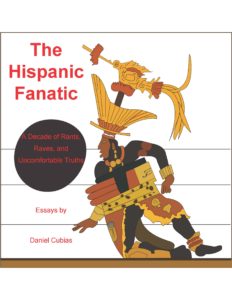
Tag: hispanic

Bonus Points If You Can Sing “The Star-Spangled Banner” In Its Proper Key

First, thanks to Gigi for her passionate comment on my post “Dogma Vs. Cheese.”

Second, let me return to the subject of my previous post, in which I advocated for amending the U.S. Constitution. I argued that being born in America should not be sufficient for citizenship. My idea is that people who want to be citizens should have to pass a test, just like naturalized immigrants do. One’s birthplace or family history would have nothing to do with it.

The piece was also published on the Huffington Post. There, I received dozens of comments, ranging from the thoughtful to the shrill. Joining the fray were conservatives who thought I was joking and liberals who said I supported literacy tests for voting. Because I pissed off individuals across the political spectrum, I figure that I must be on to something.

As an addendum to that post, let me point out that the U.S. government has recently reformatted the citizenship test. Now it’s less of a hodgepodge of rote and trivial questions, such as “How many stars are on the flag?”

There’s more of an emphasis on content, with questions like “What is one responsibility that is only for United States citizens?” In essence, you have to think a little more now.

It’s impossible to know how effective the test is unless one actually takes it. And nobody is going to devote the time, money, and stress to do that unless they absolutely have to. But there are a number of online study guides that give us a taste of what immigrants have to master.

For example, here’s the government’s official guidance on becoming an American.

Sadly, it doesn’t include tips on maintaining a hostile relationship with your next-door neighbor, or which flatscreen television you should buy that you can’t possibly afford. Clearly, there are some all-American concepts that immigrants will just have to learn on their own.

But my main argument stands: Immigrants have to learn about our country and prove their worthiness to stay, so we native-born citizens should have to as well.

In any case, if you’re so smart and bursting with patriotic vigor, let’s see how you would do on the new citizenship exam. Here’s a sample of the test.

Give it a shot, and try to imagine that your entire future rests on how well you perform on this exam.

You don’t have to tell me your score. 


Start Cramming Now

First, let me thank Evenshine for his/her thoughtful reply to my post “Dogma Vs. Cheese.” 

Second, let me give thanks in general that this election season is almost over.

One of the odder moments in this incessant campaign was when John McCain’s status as a real American became a question. I don’t mean that anyone doubted his patriotism or citizenship or anything like that. I’m referring to the skepticism expressed over whether his birthplace (a military base in the Panama Canal zone) fulfills the U.S. Constitution’s requirement that the president be a “natural-born citizen.”

It would indeed be a soul-crusher for Republicans if the guy pulls an upset in November, only to be ruled ineligible come Inauguration Day. Either scenario, by the way, is highly unlikely.

In any case, conservatives want to change the Constitution (that non-living document) by adding the “Schwarzenegger amendment,” so that any naturalized citizen can become president. But while they’re at it, they also want to amend the Constitution so that being born in America is not sufficient for citizenship.

The thinking here is that too many pregnant Hispanic women are dragging their huge bellies across the border, just so they can spit out a little nino or nina on U.S. soil. Doing so, of course, ensures American citizenship for their offspring.

I happen to agree with these proposed changes, especially amending the Constitution so that people born in America are not automatically made U.S. citizens. In fact, my compliant with this proposal is not that it is unfair or radical, but that it doesn’t go far enough.

So if we’re going to do this, let’s do it correctly:

Amend the Constitution so that no one can become a citizen until he/she passes a basic test. I mean nobody gets citizenship by virtue of where they’re born or their parents’ status. Everybody has to earn it.

This is where most conservatives pull back. They just want Diego and Maria denied rights because their parents don’t speak English. They certainly aren’t talking about limiting the status of their own ninth-generation offspring.

It’s not just selfishness. We have this mindset that people whose roots go back farther are better Americans. But individuals whose ancestors fought at Valley Forge are not inherently more patriotic than immigrants. In fact, I would argue that people who spend time, money, and effort to study our culture – then prove they know what they’re talking about – are more committed to, and knowledgeable about our nation than the millions of Americans who slept though high school history.

To be fair, I have a bias. Several members of my family have had to pass the test. I was born here, so I didn’t have to put myself on the line. But my mother, aunt, and several cousins have had to step up and say, “Hell yeah, I had to work for this.” And don’t we always appreciate things that we have earned more than gifts that are just handed to us?

And what’s so intimidating about a basic test, anyway? I’m not talking about forcing people to answer questions like “Explain U.S. monetary policy on a macroeconomic level.” The citizenship test, as I understand it, asks people things like “Why do some states have more representatives in Congress?” I find it difficult to believe that this is a harmful thing for citizens to know.

If we had informed citizens – people who really strived to be active members of this country – maybe America wouldn’t elect leaders based on how cute they are or, Lord help us, whether the majority wanted to have an imaginary beer with them.

An objection to this idea is the status of children. Are we to educate every child with the knowledge that come adulthood, many of them will be, at best, legal residents and never become citizens? Well, that’s hardly scary, because we do that now. Furthermore, I would argue for the intrinsic benefit of putting all kids on an even playing field – one where every child is a future potential president –rather than subdividing children into “natural-born citizens” and interlopers.

So what are the objections to this idea? Are they based on the principles of fairness and history, on the norms of our culture? Or perhaps we react negatively because of fear, the itchy suspicion that many of us have no idea what all those stars and stripes on the flag actually symbolize.


Aunt #1

When I was a toddler, I couldn’t pronounce her name, so I came up with a garbled nickname that I no longer use. I’ve thought about bringing it back. I think she would like that.

Aunt #1 is the only sibling of my mother whom I have ever met. She came to America after my mother had established a beachhead of sorts in this nation.

Her sensibilities are such that, once when I was a kid, I referred to someone as a “sucker,” and she lectured me on vulgarity and propriety and respect for others until I apologized. She would not be pleased to know, alas, that “sucker” is among the least profane words I use on a daily basis as an adult.

Shortly after Aunt #1 moved to America, she met a man from Puerto Rico, got married, and had three daughters (Cousins #1, #3, and #5). A quarter-century later, she divorced him. Years later, when he was stricken with cancer, she took care of him. For those of us who know her, it was an unsurprising display of patience and compassion.

Aunt #1 is the most religious member of my family. Each year, she uses a chunk of her vacation time to go on a spiritual retreat. It’s with monks and hours of meditation and no talking and everything. It requires far more dedication, faith, and discipline than I could ever conjure.

To be sure, Aunt #1 is certainly not the Bible-thumping “You’re all going to hell if you don’t agree with me” kind of fundamentalist nutjob who has given the religion a bad name. In fact, when one of the cousins came out as a lesbian, Aunt #1 offered her love, despite the huge Catholic no-no that this announcement signified.

She actually tries to live all that “Love they neighbor” and “Turn the other cheek” stuff that that many Christians reject – you know, the hard stuff. She would preach the importance of tolerance, if she preached at all, that is.

Aunt #1 is that rarest of subspecies: an actual Christian.


Dogma vs. Cheese

Among my numerous flaws is the fact that I’m not very charitable. Yes, I give money to worthy causes and all that, but I’m stingy with my time. My wife does volunteer work, which is one of the eight thousand things that I admire about her. Still, I’ve never found the energy to join her on her endeavors or to paint a dilapidated inner-city house or to devote a holiday to working in a soup kitchen or to do something else community-driven and altruistic.

My reluctance may be due to laziness or cynicism. Or it could be that my youthful stint doing volunteer work in the barrio of my hometown was less than satisfying.

I was a teenager, and I accompanied my mother on her rounds giving food to poor people. Again, I went not because I was bursting with the milk and honey of human compassion, but because my mom told me to. She needed someone to lift the heavy bags of donated foodstuffs, and I was informed that I was this person. So we drove around town, and I lugged clunking sacks up flights of stairs, entering each family’s hovel with the slump-shouldered, sullen indifference of the American teenager.

The families were overwhelmingly Hispanic, most of them recent immigrants who were still struggling with English. The land of opportunity was a lot harsher than many of them thought it would be, and they were, without exception, grateful for our help.

In fact, they were excessively grateful. I was hugged numerous times, and more than once a weary-looking Latina mother would burst into tears or repeat, “Gracias” over and over again.

This was not a moving experience for me. On the contrary, I got embarrassed. I didn’t like people falling over themselves praising me, especially when all I had done was carry some groceries. Plus, none of this charity work was my idea and all of it was against my will.

But still they went on in rapid Spanish, until my mother interrupted them to hand over the bill. You see, the food was free – but it still cost something. The price for being fed was a lecture.

The lecturer was my mother, and the topic was birth control.

My mother and I had noticed that most of the households were overrun with shrieking children. The Latino obsession with family (which I have addressed in these posts more than once) was in full flower. This was one of its negative outcomes.

So my mother tried to explain to these destitute women that they didn’t have to keep cranking out babies. She pointed out the obvious – more children meant more mouths to feed – and she tried to convince them that in America, they had freedom and choice and other abstractions that didn’t exist in their home countries.

But the lectures were not popular with the receipients. Many of the immigrant mothers were mystified about basic birth control, as if my mother were trying to convince them to buy a magic talking chimpanzee. It was just that exotic.

Those who knew about condoms and pills and IUDs usually dismissed them out of hand. It was against God, they argued, by which they really meant it was against the Catholic Church’s teachings. This showed me at a young age, as if I needed any further proof, that religion can do more harm than good and that people will abdicate responsibility for their own personal disasters under the guise of being holy. It also convinced me that Hispanics will never improve their quality of life as long as they remain fanatically devoted to the pope (see my earlier post on this).

Other excuses popped up. Some women implied that it was their culture’s way to have lots of children, oblivious to the fact that they were in America now. At least one woman said that her husband refused to wear a condom because it wasn’t manly. This was a special moment when my mother translated this particular item for me (and not awkward in the least!).

In any case, many of the immigrants had come to expect my mother’s sermon. They had to choose between having their belief system questioned or receiving those enormous rectangular cubes of cheese that exist solely for poor people’s consumption. It was their Sophie’s Choice.

So they listened, and then they said, “Gracias,” and then we left to repeat the whole futile process again.

And that’s why I don’t volunteer anymore. Or maybe I’m just lazy.


The Return

I am back from my vacation to my home state.

While there, I had a great visit with my mom, who is always the perfect host.

In addition, Aunt #1 let me know that I got a few facts wrong in my post about Uncle #1, and I learned that Cousin #1 is planning a big move (more on this later). Late in the trip, I went drinking with Cousin #6, during which one of us said something so funny that alcohol was spit out. I will not identify the guilty party.

Also, my abuela made pupusas for my wife and me, which we transported across state lines as quickly as we could before they thawed out. Their loss would have been at least a tragedy and, quite possibly, an actual crime.

I also hung out on my former roommate’s 100-acre farm (Latinos seldom get this rural, unless they’re picking lettuce), and I caught a baseball game with some old friends. And yes, our team clinched a postseason spot – most cool!

Finally, I accompanied my wife to her high school reunion, where it was verified by several of her classmates that she has aged extremely well and is – to quote one inebriated guy – “even hotter now than when she was a teenager” (let it be noted that I did not punch him).

The closest I came to updating the blog was when I checked to see how my last piece for the Huffington Post had done. I was pleased to discover that it had received seven or eight insightful comments, which I thought was pretty good until I noticed that Jaime Lee Curtis had written something in the same section that got 412 comments… come on! The woman from “Christmas with the Cranks” is pummeling me.

So it’s clear that I have to get back to work. Fresh posts are coming. Stay tuned.


The Return of the Aztec Whistles of Death

First, let me thank Stephanie for her comments on my post “Omnipotent” and for supplying a great resource on Archbishop Oscar Romero.

Second, thanks to Jeanne for her kind words (and enthusiastic encouragement) on my post “A Sort of Hajj.”

Third, I have to announce another brief hiatus.

I am taking a brief vacation this week. I will be going back to my home state to see friends and family (including the Cousins). As I mentioned in a previous post, the one thing I will positively not be doing in my home town is attending my high school reunion, but as we said back in the 1980s, “Whatever…”

The bottom line is that I won’t be updating this blog for the next week or so. I hope to publish new posts as soon as possible.

To keep you entertained in the interim, here is the creepiest story with a Latino angle that I could find:

An engineer has reconstructed the infamous Aztec whistles of death. You can see what they looked like and even hear the spine-tingling tones they emanated. As the story states, “If death had a sound, this was it.”

I mean, how cool is that?

See you all soon.


A Sort of Hajj

As I’ve mentioned before, my family emigrated from El Salvador. But I have never set foot in that country.

The nearest I have come to this familial motherland was when I was fourteen, and my mother took me to Nicaragua. As part of the trip, we climbed to the edge of a volcano (yes, my mom took me cool places when I was a child). On the climb down, my mother pulled me aside and pointed to some verdant mountains in the distance.

“That is El Salvador,” she said.

This glimpse is the extent of my first-hand experience with my family’s birthplace.

A natural question is, why did my mother and I stop at Nicaragua? Why didn’t we keep going into El Salvador?

The answer is simple: We didn’t want to die.

At the time, (circa 1985), my mother was on a Salvadoran government hit list. If she exited a plane there, she would be shot. Anyone who thinks I’m exaggerating doesn’t realize how ruthless and bloodthirsty the junta running El Salvador was at that time. My mother was a rabble-rouser in the United States, and she spoke out against the Salvadoran government (see my previous post on this). This got her noticed in her homeland. They certainly weren’t going to send some international assassination squad after her in the Midwest (it’s not a Bruckheimer movie for damn sakes), but my mother found out through her friends in El Salvador that she was on the small list of Americans who would be quickly picked up if she ever returned. Two of her siblings had already been murdered (see my previous post on this as well), so this was no joke.

For this excellent logistical reason, we were not going to El Salvador any time soon. The war has since ended, of course, and my mother has returned a few times. But I haven’t yet made the trip.

Time, money, and the myriad responsibilities of adulthood have prevented me from packing a suitcase and yelling, “Next stop, the tiny village of San Vicente.”  In fact, although I’ve lived in several cities and seen more of America than most people have, my international jaunts are limited. Besides that journey to Nicaragua, I’ve been to Mexico (which will be the subject of a future post) and traveled about nine feet into Canada once. I finally made it to Europe a few years ago, where my wife and I hit London and Paris. And that’s it.

But with all the dream destinations in the world that I have yet to conquer – drinking wine in Italy, diving off the coast of Australia, trekking to the North Pole – why am I hung up on visiting a tiny country best known for warfare and which my family abandoned a generation ago?  

After all, few people go to El Salvador unless they have family there. I suppose there are those mega-travelers who hit every nation no matter how small or impoverished. But aside from that, people generally don’t get any closer to the place than the rainforests of Costa Rica or the beaches of Belize.

However, for those of us who are first-generation, there is always the pull of a land that we have never seen, the place where our parents come from. Their memories and stories have not been decayed by time, and we feel irrational nostalgia for a place barely removed from us. We ponder how we would have turned out if we were born and raised there (I have since found out that this is metaphysically impossible… but that’s another post or maybe even a different blog altogether).

This yearning for a lost homeland is not shared by most Americans. For example, my wife is descended from German immigrants who came over so long ago that she has no idea when they arrived or what their names were. Her desire to visit Berlin is roughly equal to her interest in roadtripping to Delaware. In contrast, one of my best friends is first-generation Serbian, and his life was incomplete until he walked through Sarajevo.

Similarly, I want to see the place where my mother and aunt grew up, and the nation where several of my cousins were born, and the focal point of so much joy and misery in the history of my family.

And of course, I have more incentive to see El Salvador ever since Cousin #8 moved back there (this will be the subject of a future post).

So I hope to someday go beyond the fleeting image of that landscape I viewed from a distant vantage point when I was a teenager. For all I know, it might be decades from now, when I’m an old man doing some kind of crazy circle-of-life final journey. But I will stand on top of that lush mountain that I saw long ago and say, “Damn, I finally made it.”


The Power of the Powerless

In Europe during the Middle Ages, lepers and vagrants were often assumed to have nefarious supernatural powers. The thinking was that too much exposure to the riff-raff would cause your hands to fall off, or your baby to die, or your wife to go mad. And if the local burgermeister couldn’t get it up with his mistress-wench, it must have been because that withered crone who begs outside his door had placed a hex upon him.

The reason for this odd logic, according to some historians, is that as cities grew, a permanent underclass developed that freaked out the respectable people. The upper classes feared these cretins who dressed in rags, and to deal with this dread of the unknown (or to assuage their guilt for not helping those less fortunate than themselves), they claimed that the wretches only appeared weak. So the myth grew that some manic with no teeth and gangerous limbs could take you out if you weren’t careful.

We’re much more civilized today, of course, and we don’t blame the poor for our calamities – well, except for all those homeless guys who are making downtown unsafe… and the welfare recipients who continue to sponge the system… and those illegal immigrants who are stealing our livelihoods… and…

Wait a minute.

Yes, we do indeed go after those who can’t possibly compete with the middle and upper classes. If we’re fortunate enough to achieve a certain level of comfort, but that final rung on the economic ladder is too slippery to grasp, we blame our distress on the equivalent of Middle Age witches.

This blaming necessitates the really nifty trick or assessing that someone has no power, and therefore won’t fight back, and then ascribing enormous power to them. The tactic is especially common in prosperous societies, where people have more possessions and, therefore, have more to lose.

A crazy homeless guy ranting about God reminds us of our potential to bottom out more than it would in say, Sierra Leone, where poverty is a widespread fact of life.

Similarly (and most importantly from this blog’s perspective) a team of illegal immigrants clambering over the neighbor’s roof, laboring mightily in the summer sun, invokes a fear in middle-class Americans that these hard-working strangers are willing to do whatever it takes to get ahead – and that means they’re coming for our nice cars and fancy televisions and 80GB ipods and crème brûlée torches (by the way, this last item is real and exists solely for people who have way too much disposable income).

It’s been pointed out that immigrants are often the boogeyman for societal problems. Just look at Martin Scorsese’s “Gangs of New York” to see how despised the Irish were.

So now it’s the Latino’s turn to be scorned and feared.

Naturally, there are clear objections to the idea that illegal immigrants are modern-day scapegoats. Foremost among them is that undocumented workers are not cost-free to the economy, nor are they incapable of criminal behavior. In other words, negative reactions to illegal immigrants are not solely based upon made-up superstitions.

However, the depths of hatred for these individuals, and the vast influence ascribed to them, boggles the mind. Any sensible discussion of immigration reform is doomed once it’s declared that a guy making sub-minimum wage who lives in constant fear is really the secret strongman.

So do we go on blaming the powerless?

Personally, I’m going to try to take more responsibility for my issues – unless of course I can turn this around and blame someone much, much more powerful than me, like the government or Big Oil or the Bavarian Illuminati.

OK, now I’m on to something.


el futbol americano

Football season began this weekend, and like millions of other people, I will spend far too much time over the next few months getting emotionally attached to meaningless events beyond my control. My mood on certain Sundays will depend on whether or not an enormous, steroid-enhanced millionaire in a bulky uniform can catch a weirdly shaped spinning object.

There are, of course, few Hispanics who play professional football. Genetically, we tend not to be that big, which is a serious disadvantage in a game based on brute force. Once you get past Tony Gonzalez of the Kansas City Chiefs and a few diminutive place-kickers scattered around the league, the NFL isn’t exactly awash in Latinos. Still, we will soon have at least one honorary Hispanic take the field.

Chad Johnson, a receiver for the Cincinnati Bengals, has legally changed his name to Chad Ocho Cinco. For those of you who passed freshman Spanish, you know that “ocho cinco” means “eight five.” It’s a reference to Johnson’s jersey number (eighty-five), although strictly speaking, he should have changed his name to Ochenta y Cinco.

He first slapped “ocho cinco” on the back of his jersey in 2006, when the NFL celebrated Hispanic Heritage Month (which, by the way, is in September). He wore it for pregame warm-ups, but had to remove the moniker for the game because the NFL pointed out that it wasn’t his real name. Well, it is now, and his jersey will indicate as much while we hear the pleasing baritone of sportscasters intone, “and the pass is complete to Ocho Cinco.”

As someone who also changed his last name to reflect Hispanic heritage, I can understand Johnson’s… I mean Ocho Cinco’s decision. Why not choose a name that better reflects your personality, and that has the added benefit of paying tribute to an oft-marginalized culture? And really, how attached could the guy be to the name “Johnson” anyway?

There are a couple of differences between me and Mr. Ocho Cinco, however. First, I’m truly Hispanic, and he’s not. Actually, I don’t have to enumerate any other points besides that one. But I will add that I chose my mother’s maiden name as my new surname, bypassing the megalomania inherent in picking a random number that celebrates just me and my greatness.

In any case, Ocho Cinco joins the very short list of celebrities who have changed their names to something Hispanic or, at the very least, expressed a desire to be Latino. It’s further proof that our hipness level is slowly, incrementally rising.

I am not a Bengals fan, but I hope Ocho Cinco does well this year. After all, if he sucks, we’ll hear, “He was pretty good, until he decided to get all Hispanic on us.”


Omnipotent

Forgive me for being a bit tardy on this news item, as well as for straying – initially at least – from my professed subject matter.

But I’ve been thinking a lot lately about Bristol Palin, who is, as you know, the Republican VP candidate’s poor knocked-up teenage daughter.

Religious conservatives have rallied around the girl and said that her condition is nobody’s business, or that it is actually good news because it verifies Palin’s pro-life credentials. So as a thought experiment, let’s reverse the situation:

Say that Obama or Biden had a 17-year-old daughter who got pregnant and is keeping the baby. Would we hear from social conservatives how it’s irrelevant, or proof of the candidate’s humanity, or even inspiring?

More likely, we would hear how liberals don’t instill proper values in their children, or that they don’t respect traditional family values, or that their lax parenting proves their inability to lead the country, or that it all sets a poor example for young people.

My point isn’t that religious conservatives can be hypocrites, or that abstinence-only sex ed doesn’t work, or that this girl’s condition has become a campaign issue (although to be honest, all of that is true). Rather, this is my long-winded way of addressing the powerful and detrimental nature of religion in American culture.

So what has this, specifically, got to do with Hispanics?

Well, as you may or may not know, Latinos are the alpha and omega of Catholicism in the United States, and perhaps the world. Consider that in America, almost 70% of Hispanics are Catholic, compared to just 20% of the general population. Some countries in Latin America are as Catholic as Middle Eastern countries are Islamic.

Has all this religion helped the Hispanic community? I would argue that it has not.

The stranglehold that the Catholic Church has over Hispanic culture has bred a unique form of interdependence. Faith in God’s master plan has superseded faith in one’s abilities and talents. This latter type of perseverance – call it secular if you want – is more needed than ever in communities where deep-seeded problems demand creative answers. Instead, with all the issues facing the Latinos, prayer is the answer most often given as a viable solution.

For a more specific example, let’s look at the horrific graduation rate of Latino adolescents. It’s no surprise that Hispanic teens lag so far behind white, black, and Asian American students in actually getting through high school. The priority that Latino culture places on religion dwarfs the attention given to education (I will post more on this discrepancy later). Especially among immigrant parents, making sure that a kid does all his homework is not nearly as vital as ensuring his attendance at Mass (I will add that my mother was an exception to this mindset, which was to my great benefit).

Social conservatives love to proclaim that issues in barrios and hoods exist because the people who live there have grown too dependent on government largesse to fend for themselves. They may have a point.

However, their alternative has often been to push for more dependence on Christianity, a cultural force that, unlike government, isn’t accountable to voters. How else do we explain the dreaded faith-based initiative?

A natural objection to all my negativity is to point out the good that religion does. Indeed, many people have turned their lives around because of a newfound faith, and some of our greatest leaders (eg, Martin Luther King Jr.) were driven by religion. And in Latin America, numerous priests in Central America – to say nothing of the great Archbishop Oscar Romero – have sacrificed their lives for a greater good.

Still, at this point in history, is the net effect of religion in general (and Catholicism on Latino culture specifically) a positive? My belief is that it ultimately does more harm than good.

So I’m pleased to see that young Latinos, like the younger generation overall, are at least pausing to consider if all this praying is really worth it.

A report by the University of Notre Dame’s Institute for Latino Studies shows that Hispanics become less Catholic with each U.S.-born generation. This lines up with surveys showing that the number of nonreligious young people (those from 18-25 years old) has nearly doubled over the last generation (from 11 percent in 1986 to 20 percent today).

This should not be construed as a clamoring for atheism or a call to burn down all the churches. Rather, it is quite possibly Latino culture’s gradual realization of the need for balance.

And perhaps it is the recognition that going to church and worshipping really hard is not sufficient to raise our standard of living. Maybe Hispanics are learning that, you know, God helps those who help themselves.


  • Calendar

    October 2026
    M T W T F S S
     1234
    567891011
    12131415161718
    19202122232425
    262728293031  
  • Share this Blog

    Bookmark and Share
  • My Books

  • Barrio Imbroglio

  • The Bridge to Pandemonium

  • Zombie President

  • Feed the Monster Alphabet Soup

  • The Hispanic Fanatic

  • Copyright © 1996-2010 Hispanic Fanatic. All rights reserved.
    Theme by ACM | Powered by WordPress