Tag: hispanic

Old at Heart

Like many Gen Xers, I’m pretty tired of hearing how great the Baby Boomers were. Yes, they had amazing music, and that whole civil rights crusade is tough to top.

But as they age, Baby Boomers have made it clear that their bell-bottomed, peace-and-love, tune-in-turn-on idealism was a convenience of their youth, or it was the result of a loud minority that never reflected how most of them really felt.

I say this because recent surveys have shown a generation gap (really a chasm) between older and younger Americans on just about every social issue.

Perhaps this isn’t a big surprise, as people tend to get more conservative as they get older. But even with that caveat, some of the attitudes that Baby Boomers (especially white seniors) hold are alarming to Gen X and Millennials.

For example, more than half of white seniors “view the rise of newcomers from other countries as a threat to traditional American values and customs.” Let’s just say that most young people (many of whom have immigrant parents) don’t see things the same way.

And as anyone who has seen footage of a Trump rally can tell you, “much of the older white population — especially less-educated white males whose anger is being courted — appears threatened by the nation’s demographic change.”


Indeed, 60 percent of the white working class believe “that discrimination against whites has become as big a problem today as discrimination against blacks and other minorities.”

In addition to being whiny, narrow-minded, and xenophobic, this attitude is — how should I put this? — fucking suicidal.

You see, the “demographic reality is that America’s youth — and more specifically its racial minority youth — is its future.” That’s because Millennials are the most ethnically diverse generation in American history, and their future kids will be even more mixed. So there’s no going back to a 1950s mythological USA where everybody was white and things were gosh darn swell.


1950s

It also means that “because of the growth of Hispanics, Asians, blacks and other races, the United States will be able to replenish its younger population.”

Going forward, this implies that “America will not suffer a European-style demographic crisis as Baby Boomers retire. Young Latinos are stepping into the workplace and paying the taxes that will keep the nation’s fiscal house in order.”

Keep in mind that when it comes to Hispanics, we “are much younger than Americans as a whole, and young Latinos in America are better educated and earn more than ever.”

The bottom line is that “to ignore or wish away the nation’s youth-driven minority growth is short-sighted as a national economic development plan.”

Very soon, old Baby Boomers are going to be dependent on young Latinos to fund Social Security. But try explaining this fact, and you’re likely to be drowned out by a sixty-something cranking up Joni Mitchell’s Woodstock.

Yeah, I guess those were the good old days.


Wall of Denial

Yes, we’ve all been highly entertained by the chaos, comedy, bluster, and insanity of this year’s presidential campaign.

And perhaps no single concept illustrates the bizarre, parody-proof nature of this election more than Donald Trump’s plan to build a “big, beautiful wall” along the Mexican border.


pinkfloydwall

This idea is hugely popular with his base, many of whom are rather overt about their preferences for a certain type of skin hue. But other supposedly rational people are onboard with this proposal. Its simplicity speaks to them: “It will keep out all the illegals!”

So John Oliver recently devoted a segment on his show to how realistic Trump’s wall really is.

Just to summarize his findings, it seems that the wall would cost $25 billion to construct, and billions more per year in maintenance costs.

But that’s not our problem — right? Because Trump is going to make the Mexican government pay for it.

Well, the Mexicans themselves have no intention of spending money on this xenophobic folly, and we have no real way to make them do so.

Except of course, if we go to war over it, which Trump has not ruled out.

Naturally, we have to ask if this wall thing is really fighting about.

Well, building a wall presupposes that America is being overrun by… well, you know who.

But in that place called reality, immigration of all types — legal or illegal — is down. In fact, “the number of immigrants living in the U.S. illegally is at its lowest number in more than a decade.”

And despite all the fear, hatred, and blame thrown at undocumented people for their supposed killing and raping, the truth is that “immigrants are less, not more, crime prone than their native-born counterparts.”

So the wall would be a drastic solution to a problem that is overblown in the first place, and that is resolving itself.

Thus, the bottom line is this series of questions:


Do you really think the United States can force Mexico to pay for a wall?

If not, do you believe we should go to war —literally killing Mexicans and sacrificing American troops — over this?

If not, are you willing to cough up $25 billion (just to start) to construct this thing?

If so, are you aware that illegal immigration is down and undocumented immigrants are actually less prone to crime?

If so, are you aware that a wall will be of limited usefulness and not stop people who are truly determined to come here?

Answering these questions brings us to a pair of incontrovertible conclusions.


If you support the idea of a wall, you are possibly a racist.

But if you honestly believe a huge wall is going up in your lifetime — regardless of who is elected president — you are either delusional or actively stupid.

Now that’s simplicity.


Semi-free Speech

I try to avoid the whole WWJD game.

And I don’t apply this rule solely to Jesus. I also avoid asking what would Gandhi do, or Abraham Lincoln do, or Jimi Hendrix do.

The reason is that we can’t possibly know what these individuals would think of modern problems because they are so very, very dead. And whenever someone asks that question, the answer is inevitably, “Well, Jesus would agree with my exact political views, of course.”

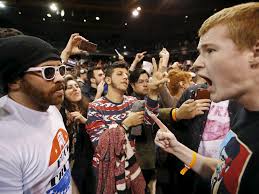
However, I am going to break my personal rule by asking what would MLK think of last week’s Trump rally in Chicago, where fistfights erupted, some crazy old lady flashed a Nazi salute, and the frontrunner to be the Republican nominee for president cancelled his speech.

trump rally

As I understand it, Martin Luther King was in his fair share of tense situations. And yet I don’t recall hearing of a single time when he shouted down someone who disagreed with him, or reveled in acts of violence. He simply didn’t do that.

And yet, I see plenty of liberals out there who insist that we “won” in Chicago. What kind of odd reasoning is this?

Shutting down one bigot for one night is hardly a victory for tolerance and respect. Because “even the most ardent anti-Trump among us should lament that a political speech was canceled due to fears of violence.”

Yes, I know that Trump is loathsome and would happily take away your freedom of speech if he could. That’s not the point. The issue is that “no matter how right you think you are, you are never so clearly right, never so without fault, never so pure, that you have any moral authority to shut down the other side with violence.”

So preventing Trump from speaking in Chicago was not a bold cultural statement. It is also not going to change anyone’s vote in November.

All is did was make leftists feel good about themselves for a couple of hours.

Now, I understand the frustration. And I don’t know why apparently rational Americans are supporting a man who loudly proclaims his bigotry and misogyny.

Maybe it’s what the late, brilliant monologist Spaulding Gray believed, which is that there are times and places where malevolence just appears. As Gray said, there is “perhaps an invisible cloud of evil that circles the Earth and lands at random in places like Iran, Beirut, Germany, Cambodia… and America.”


Now or Never

So the 2016 presidential election will come down to Latinos… or millennials… or Latino millennials who live in purple states and have flirted with veganism and have bought at least one Kayne West album. Who really knows?

However, the best predictors we have are that the so-called Trump factor has increased Hispanic voter registration, especially among young Latinos. This would seem to spell doom for the GOP, except that, as many Americans have seemed to forgotten, “Hispanics have historically turned out on election day in lower rates than other groups — a factor compounded by the high percentage of young people, who also vote less frequently than older Americans.”

Yes, there’s an undeniable appeal to the image of millions of 18-year-old Latinos standing up, saying no to racism, and eagerly casting their ballots against a megalomaniacal billionaire. But it’s unlikely to happen in the real world.

Still, Hispanics will have a stronger impact in 2016 than they have previously. For example, some experts say Latino turnout will top 13 million this year, up about 17% from the last presidential election. And this would also represent about a 9% increase in the Latino share of the vote. Those are all good numbers.

Furthermore, “this is bad news for Republicans given that a recent analysis shows that even if 60% of the white electorate votes for the GOP (which hasn’t happen since 1988), Trump would still have to get between 42-47% of the Latino vote to win (Mitt Romney received only 27%).”

In addition, “hardline immigration policies and racially charged rhetoric from Republican presidential candidates have all but ensured that Latinos will turn out for Democrats in the general election.”

Wow, this thing looks to be over before it’s even begun.

But we’ve seen predictions like this before, especially regarding Latinos. In fact, Hispanics been referred to as a sleeping giant so many times and for so long that perhaps we should create an ethnic flag and make that image our insignia.

the_sleeping_giant_by_yngvemartinussen-d7idiwi

As such, it truly seems that 2016 is time to put up or shut up. Either Latinos are finally going to vote in numbers more indicative of our strength, or we’re going to continue leaving the fate of the country to octogenarians who are inexplicably more motivated.

After all, this year we have a bigoted loudmouth insulting us to our faces. What more do we need?


Help Is (Not) on the Way

I’ve never been in therapy. I don’t say this as a boast, just as a simple acknowledgement of luck.

You see, I’m fortunate in that I’ve haven’t been afflicted with depression or addiction or any of the myriad issues that arise when brain chemicals go all kabloowy. Nor have any of my personal traumas been so severe that I had to address the PTSD of it all.

But as we all know, many people aren’t so lucky. It’s estimated that around one in five Americans suffers from mental illness at some point in their lives.

And now comes news that for Latino youth, the numbers are on the rise. A recent study showed that “an alarming rise in the psychiatric hospitalizations of Latino children and young adults in California, even compared to the youth of other ethnicities.”

Between 2007 and 2014, the rate of mental health hospitalizations of young Latinos (age 21 and younger) jumped 86 percent.

upward-graph

Why is this?

Well, researchers believe that “a number of social issues play a part in the trend, including the recession, separation and disintegration of families, and the trauma of escaping the violence in their home countries.”

In addition, a “lack of culturally and linguistically appropriate psychiatric services available” means that young Hispanics often don’t get help addressing their festering problems, with the result that they eventually blossom into full-fledged crises that require hospitalization.

Also, one has to wonder if being constantly demonized gets under the skin of young Latinos. But this very fact — that so much of America despises Hispanics — provides another reason why this issue is unlikely to get better any time soon.

It’s a vicious, and rather sick, circle.


Fading Into Insignificance

This weekend, Chris Rock will host the Oscars, during which he will — maybe, possibly, in all likelihood — address the fact that the last 40 acting nominees have all been white. He may also mention that the track record of behind-the-scenes nominees (e.g., writers, cinematographers, and so on) is even more dismal.

Now, many people have hyperanalyzed the reasons why the Oscars are so white, and why the film industry lags behind other art forms in projecting America as it actually exists, and whether or not this is all a misunderstanding or deeply ingrained racism.

I’m not going to recap all the backlashes and counter-backlashes that this mess has conjured up. But I do want to point out one very telling, almost universally ignored aspect of this controversy.

BRENTWOOD, CA - FEBRUARY 24: Nate Sanders displays the collection of Oscar statuettes that his auction company will sell online to the highest bidder on February 24, 2012 in Brentwood, California. (Photo by Toby Canham/Getty Images)


You see, the Academy has announced that it is changing the rules, and eliminating people who are no longer active in the film industry from its roster of voters.

This has predictably riled up those long-time Academy members who are in the twilight of their lives, many of whom are crying, “Ageism!” They may have a point.

But what I find interesting is that, in the reasons and justifications for their opposition to this rule change, more than one Academy member has said that it is unfair to ethnic minorities. As many commentators have noted, “if there’s a black Academy member out there who agrees, please do get in touch.” And yet, many people still embrace the idea that altering the status quo to increase diversity is actually a bigoted response.

What does this tell us?

Well, for starters, it shows once again that people who are accused of being racists will often turn around and shout that their opponents are the real racists. It’s a nifty bit of swift-boating.

It also reveals that acknowledging an institution’s biases — and by extension the touchy topic of white privilege — causes people to freak the fuck out and get more than a little defensive.

But more than anything, it serves as direct evidence that white people in positions of privilege, such as rich Hollywood types, feel that they can pontificate on any issue and shout down any viewpoint different from their own.

Think about it. Here you have a wealthy white person deciding what is and isn’t fair to ethnic minorities. He or she isn’t concerned with whether or not ethnic minorities perceive it that way. Privileged individuals are used to having their voices heard, so why should this subject be any different?

In this way, they prove, unintentionally of course, that there really is a racial problem in Hollywood. After all, this is a case of rich white people saying, “There, there, all you struggling blacks and Latinos. We’ve decided that your proposed solution is actually harmful to you, and in our great magnanimity we’re going to fight against it — for all of you, of course.”

It doesn’t get any more arrogant.


Genuine Imitation

When Senator Ted Cruz won the Iowa caucuses, many media outlets noted that he became the first Hispanic to win a caucus, anywhere. But that milestone quickly became subsumed in a discussion of whether Cruz was really and truly Hispanic. Perhaps he was one of those LINOs (Latino in name only), or as I heard growing up, a coconut (brown on the outside and white on the inside).


[ File # csp6110028, License # 1325460 ] Licensed through http://www.canstockphoto.com in accordance with the End User License Agreement (http://www.canstockphoto.com/legal.php) (c) Can Stock Photo Inc. / margo555

Personally, I accept both Cruz and Marco Rubio as Latino. But clearly, neither is illustrative of the Hispanic experience.

For example, picture Rubio playing up his family’s immigration experience to a crowd of Latinos in Texas. “Yes, my family came from Cuba, which means we were granted special status and didn’t have to worry about ICE raids like all of you. Now who wants me to kiss one of their niños?”

Or imagine Cruz talking about his privileged past to a crowd in East LA. That’s about as likely as him playing up the fact that he was born in Canada (which is apparently still a shocker to many Republicans), or denying the scientific consensus that he has a creepy face.

But it’s much more than their backgrounds, of course. As president, neither would tackle issues crucial to the Latino community. Rubio has flip-flopped so many times on immigration that it’s impossible to know what he believes. Perhaps more refreshingly, Cruz is upfront about his right-wing insanity, so we know he really couldn’t care less about affordable health care or better schools or other touchy-feely concepts that Latinos inexplicably want addressed.

As such, I would never vote for either of these guys, and stats show that most Latinos agree with me and, furthermore, aren’t too wild about the GOP in general.

But like it or not, they are both Hispanic. In any case, I’m not one to pass judgment on their Latino bona fides.

I’m fairly light-skinned for a Latino. I’ve never been to my family’s homeland (El Salvador). And my Spanish is lousy (ok, maybe a little better than Cruz’s). So does all that make me a fake Hispanic?

I hope not, because in that case, I would have to change the name of this website.


Family Far and Wide

So I was at the ophthalmologist’s office, getting my yearly exam to make sure glaucoma hasn’t kicked in, or that my retina hasn’t detached (again).

In any case, the nurse looked at my chart and said, “Hey, we have the same last name.”

Now, the only people I’ve ever met with my last name are cousins or aunts or some other semi-immediate family member. So this was a little surprising.

The nurse made me go through my family history, and we discovered that we have the same great-grandfather (!). Yes, I too am impressed that I was able to remember the name of my great-grandfather. Try it sometime — it isn’t easy.

According to my subsequent Google research, the nurse and I are second cousins. She was California-born, which makes sense in that the largest population of Salvadorians (outsider of El Salvador, of course) is right here in Los Angeles. And she assumed, naturally, that I was also a SoCal native.

“No,” I said. “I’m from Wisconsin.”

Consider her mind blown.

Yes, the nurse was impressed that our family name had made it all the way to the American Midwest. But then she added that some of her cousins (my third cousins?) moved to Melbourne a decade ago.

“I talked to them on FaceTime a few weeks ago,” the nurse said. “They have these El Salvadorian kids who have thick Australian accents.”

Well… crikey.

nw-gal-aus-20140125214254582223-620x414


Later, I told my mom about running into my second cousin, the nurse. Mi madre really wasn’t that surprised.

“Your great-grandparents had eighteen children,” my mom said.

“I’m guessing they were very Catholic,” I said.

“Yes, so you were bound to run into a cousin someday.”

OK, that’s true. But I still thought it was kind of cool.


The Urge to Merge

I know what you’re thinking.

“Hey, Hispanic Fanatic, wouldn’t this country be better off if huge corporations called more of the shots?”

Yes, I’m nothing if not a shill for the benefits of global conglomerates having even more control over our society. I mean, when has big business ever screwed us over?

Puppet master


While you ponder that most rhetorical of questions, I will draw your attention to a recent study that looked at media company mergers.

Researchers at Columbia University’s Center for the Study of Ethnicity and Race analyzed media company mergers after 2008, but they focused on the Comcast-NBCUniversal deal because it was the largest and well documented.

Now, remember that one of the many arguments that media groups make when merging is that their new tentacled beast of an organization will increase racial and ethnic diversity. These new companies will also make the internet free, cure cancer, and teach your dog to speak, but I digress.

So how did the Comcast-NBCUniversal merger do?

Well, the researchers found that “despite a pledge to increase Latino representation in programming, there was no significant increase in diversity behind the camera.”

The percentage of Latino directors went up a meager 0.8% after the merger. But the percentage of Hispanic producers, executive producers, and writers all actually decreased.

Yikes — that ain’t so good.

To be fair, the study also found that the percentage of Hispanic actors onscreen increased from 6.6% before the merger to 7.3% afterward. That’s good news, right? Well, even that mild improvement comes with a caveat, as deeper analysis shows that this increase “was accompanied by a significant rise in Latino stereotypes on NBCUniversal. Latinos who appeared as maids, janitors, [and] inmates” nearly tripled from 2008 to 2014.

Basically, more shows were hiring more Hispanics to appear as servants and thugs.

Yay for progress!

By the way, before the merger, Comcast and NBCUniversal had no Latino executives. But today, 4 out of 130 senior executives are Latino, accounting for 3.1% of upper management. However, only one (yes, one Latino executive in the whole company) holds a position outside of Telemundo.

Now, one can look at this study and link it to the current uproar that Hispanics, African Americans, and Asian Americans are a combined 0-for-40 when it comes to recent Oscar nominations for acting.

When we do that, we must come to the conclusion that, as the researchers so diplomatically put it, “The agreements and promises made before the merger [aren’t] really panning out.”

But I’m sure things will be different when the next big media merger happens. Next time, all their promises will magically come true.

Yup.


A Latino Millennial Walks into a Bar…


We Latinos are known for many positive characteristics, such as our strong family bonds, fierce work ethic, and inherent sexiness (really, it’s a thing).

However, we don’t have the reputation of being particularly funny people. As I’ve written before, Hispanic equivalents to Jon Stewart or Chris Rock or Tina Fey are tough to name.

But maybe that has less to do with culture than with access.

Historically, there has been no hub for Latino comedy. To fill that niche, Broadway Video Enterprises (founded by SNL creator Lorne Michaels) recently launched Más Mejor, a new online comedy studio powered by Latino voices.

The site will feature content by Hispanic comedians and/or about Latino themes. Among the big names involved are SNL alumni Fred Armisen and Horatio Sanz, who joined together to contribute one of Más Mejor’s most popular videos so far. Other early hits include a takedown of Mexico City’s tourism campaign and a jab at every Latino’s favorite presidential candidate, Donald Trump. Future content will include topical sketches, cultural and political satire, and original web videos.

One of the site’s partners is Batanga Media, which will distribute premium content to its 70 million monthly users.

Rafael Urbina, CEO of Batanga, agrees that few Latino comedians have broken through to the mainstream. But he sees that as less of an issue — and even less of a goal — going forward.

“Crossing over into the mainstream is great,” Urbina says. “But Más Major isn’t so much about breaking through to the traditional media. It’s more about engaging with the audience directly.”

Urbina points out that Latinos in general, and young Hispanics in particular, are voracious consumers of online media. For example, Hispanics watch 62 percent more digital video than non-Hispanics.

To a Latino Millennial, therefore, it doesn’t matter if a comedian has his own Comedy Central show or was featured in a Judd Apatow movie. All that matters is whether the guy makes them laugh when they click on a video downloaded to their phones.

© Copyright 2013 CorbisCorporation

“We can reach exactly who we want to reach, and not have to water down the content in hopes of reaching a mass audience,” Urbina says. “If we do that well, we will create our own mass audience. A new mainstream.”

It’s an ambitious goal, and one that goes beyond proving that Hispanics can be funny. If Más Mejor is successful, it could indicate a new model not just for Latino audiences, but for an increasingly digital world.

Urbina adds, however, that one element will always be essential when it comes to great comedy.

“Authenticity is a key pillar,” he says. “Young Latinos love comedy, and if people are authentic and talented, we now have a way for them to build a dedicated following.”


  • Calendar

    October 2026
    M T W T F S S
     1234
    567891011
    12131415161718
    19202122232425
    262728293031  
  • Share this Blog

    Bookmark and Share
  • My Books

  • Barrio Imbroglio

  • The Bridge to Pandemonium

  • Zombie President

  • Feed the Monster Alphabet Soup

  • The Hispanic Fanatic

  • Copyright © 1996-2010 Hispanic Fanatic. All rights reserved.
    Theme by ACM | Powered by WordPress