Tag: latino

A Priest, a Rabbi, and Latino Walk Into a Bar

Here’s a quick shout out to Frankie, Ankhesen, Ulises, and Chris for their comments on my recent posts. Thank you all, and thanks to everyone who shares his or her thoughts here.

But now let me backtrack a little.

Recently, I used my cyber bully pulpit to disparage comedian George Lopez and, by extension, anyone who thinks that he’s funny. I’m not backing down on my criticism, but I need to qualify it.

You see, I’ve written much about the positive aspects of Latino culture, such as our strong familial ties and powerful work ethic and openness to share emotions and many other good and true characteristics.

But I’ve also written about some less uplifting traits. And to that list, I have to add one more item:

We’re not particularly funny people.

I realize this is a gross generalization. I’m sure that plenty of Latinos are hilarious. It’s just that I haven’t met them or seen them on television or watched their stand-up routines.

We have to be honest and say that no Hispanic has ever really made America laugh, except maybe Cheech Marin, and he put the low in low-brow.

Indeed, the first Hispanic sitcom, back in the 1980s, was “Aka Pablo,” starring Paul Rodriguez. It was such a monumental flop that Latinos have been rare on comedies ever since (by the way, my hatred for this short-lived show is so intense that it demands a full post sometime).

The first Hispanic comedian to receive any kind of mainstream success in America was Cantinflas, a star from the 1950s. You are forgiven if you don’t know who he is. The guy seems to be more of poor man’s Charlie Chaplin than anything else.

One could argue that Latino culture’s history of death, destruction, and poverty does not lend itself to big laughs. That may be true, but then what do we make of the fact that some of the most insightful and cutting comedians of the last few decades have been black? Think of the line from Richard Pryor to Chris Rock and beyond. African Americans, of course, have just as much, if not more, misery in their collective backgrounds. They have apparently been better able to mine this history to create cutting-edge observations.

As a result, black people have Dave Chappelle. We have Carlos Mencia. That contrast is just depressing.

Similarly, a look at Jewish comedy reveals such heavy hitters as Woody Allen, Jerry Seinfeld, Judd Apatow, and others too numerous to mention. We’re talking about decades of mainstream success across a wide range of styles. And of course, Jews have endured one or two negative developments over the course of their cultural history. It hasn’t stopped them from coming up with a witty line now and then.

So why aren’t we funnier? I haven’t the slightest idea. But with this blog, I’ve tried to avoid becoming a writer who is, in the words of the great humorist Spalding Gray, so very “earnest, earnest, earnest.” That seems to be the default setting for many Latinos (and many bloggers, while we’re at it). By the way, Spalding Gray was a white guy.

In any case, the situation for Latino humor is grim… hey, I guess that was a joke, given the subject matter.

Yes, as you can see, you don’t want me to accept the challenge to be the comedic Latino. I’m just not that funny.


Called out on Strikes

First, let me acknowledge Henna, Cold Spaghetti, Island Meri, and Steven for their recent comments. I appreciate your thoughts.

Second, let me segue from thanks to apologies. Specifically, I may owe one to Sammy Sosa.

In a recent post, I wrote about Sosa’s apparent use of a skin product designed to make him appear whiter. I wondered if the baseball great’s light skin was a capitulation to the colonizer mentality. This mindset holds that anything white is superior, and it has caused many black people to go to absurd lengths to seem whiter (both culturally and literally).

As we know, Hispanics can be of any race. Sosa, a Dominican, is obviously a dark-skinned Latino. Many people have wondered if he is trying to renounce his Hispanic and/or black status.

As it turns out, maybe Sosa isn’t to blame if he wants to be white. Apparently, some of the man’s fellow players think that he is not really black in the first place.

Specifically, Angels outfielder Torii Hunter, a great player and multiple All-Star, believes that black players from Latin America are “imposters.” Hunter said that he and his fellow African American players “have a theory that baseball can go get an imitator and pass them off as us. It’s like they had to get some kind of dark faces, so they go to the Dominican or Venezuela because you can get them cheaper. You can get a Dominican guy for a bag of chips.”

I must admit that I didn’t know the rates for Dominicans were so reasonable. Perhaps we should all get one.

Hunter goes on to pose the ultimate rhetorical question about a former MVP. Hunter asks, “Hey, what color is Vladimir Guerrero? Is he a black player? Come on, he’s Dominican. He’s not black.”

I have no idea if Guerrero considers himself black. Perhaps he answers, “Hispanic” or “Dominican” or “human” or “right-handed slugger” when asked about his status. But he’s certainly within his rights to say, “black” or “black Latino.”

In the picture below, Hunter is on the left. Guerrero is on the right. One of them is positively not black.

Perhaps Hunter meant that Guerrero and other players from Latin America are not African American. That’s a noncontroversial point. However, Hunter comes across as a cultural jingoist, reminiscent of people who said President Obama is not really black.

His comments bring up the whole messy topic of how we categorize race and ethnicity, and why. I’ve written before about this, and several readers have chastised me for (among other offenses) saying that Chicanos are Hispanic and Spaniards are not. I’d like to think, however, that I was a bit more diplomatic than Hunter.

Perhaps we are indeed all too hung up on race and who is one category and who is not. But to deny that these constructs – artificial as they are – actually exist is to deny their power. And that’s why, despite the earnest pleas of many Americans, we will go on talking about race and racial matters.

As for Hunter, he has claimed that his comments were taken out of context. If so, it lessens the creepiness of their content, but not the stupidity of their mere existence.

Hunter ended his racial-conspiracy rant by saying, “I’m telling you, it’s sad.”

Oh, it’s sad, alright. But not in the way that Hunter thinks. It’s sad that he said, “They’re not us” when referring to teammates like Guerrero.

As the baseball writer Craig Calcaterra points out, “the fact that more and more of baseball’s black players happen to come from a couple hundred miles south of an artificial political border doesn’t mean that there is no one around to receive the torch passed down from Jackie Robinson.”

In fact, many of those players who thrive under Robinson’s legacy are Hispanic. And yes, they may even be black too.


Expats vs. Immigrants

The waiter approached our table and recited the specials in a flowery French accent. Because I live in Los Angeles, I assume that every waiter is an actor, especially ones who are speaking with outrageous inflections.

But as it turned out, he was the real deal. Over the course of the dinner, he informed us that former Parisians constituted most of the restaurant’s staff. Evidently, the owner was from France, and he liked to help his fellow countrymen get started in this country.

“So you’re an expatriate,” I said.

“Oui,” he answered.

Now, I’m certainly not going to claim that the French are wildly popular with Americans. After all, it wasn’t so long ago that people in this country were ordering freedom fries.

Strangely enough, I don’t recall anybody asking for a freedom kiss. But I digress.

The point is we can all agree that Europeans, in general, receive kinder greetings here than do people from Latin America. In fact, it’s in the very terms we use.

The French waiter was an expat. It’s a word that evokes a daring and exotic nature, an upscale sensibility. It’s a positive term.

In contrast, we refer to Guatemalans and Colombians and Ecuadorians as immigrants. That word conjures up a lot of connotations, but most of them, alas, are not positive.

What is the reason for this dichotomy?

Certainly, legality has something to do with it. I presume that the French waiter has a work visa. The Mexican busboy, in contrast, may not. But as I’ve written before, the self-righteous screeching over the “illegal” part of the phrase “illegal immigrant” doesn’t stand up to scrutiny. It’s a point, yes, but a minor one.

The differentiation, according to one unimpeachable source, “comes down to socioeconomic factors… skilled professionals working in another country are described as expatriates, whereas a manual laborer who has moved to another country to earn more money might be labeled an ‘immigrant.’ ”

It’s an arbitrary, even unfair, definition. But it’s accurate.

Still, that doesn’t explain the difference fully. For example, we would never call someone a Mexican expatriate, even if she were a successful businessperson like the owner of the French restaurant. She is forever an immigrant.

At its most basic level, the reason that we view Frenchman and German women and British people as expats, rather than as immigrants, is because we like them better. We respect them more.

It’s right there in the language.

It works the other way too. Any American adult who chooses to live abroad is an expatriate (with the possible exception of Peace Corps volunteers). It really doesn’t matter if you bum around Europe for years or head up the international office in Hong Kong. If you’re an American living in a foreign land, you’re an expat. You won’t be called an immigrant unless a native resents your presence, and even then, you’re more likely to be called “gringo,” “yanqui,” or “member of the invading imperialist army.”

There is, of course, a long history of Americans moving abroad to have their art better appreciated, or at least to sleep with people who have more interesting accents. It’s the Lost Generation of Hemingway, and the Beat Generation of Kerouac, and the Brooding Generation of Johnny Depp (he lives in France, you know).

So perhaps I will do my part and live out that dream I have about moving to London. It might be amusing to see the British try to figure out if I’m an American expatriate or a Latino immigrant.

Perhaps I would be both.


The Power Duo of Lopez & Gonzalez

My wife and I were driving down the Sunset Strip when we were taken aback by one of the area’s numerous gargantuan billboards. To our horror, leering over us was the mugging face of comedian George Lopez. The enormous ad promoted his talk show or an upcoming movie or something else low-class that he’s involved in.

My wife looked at the billboard and said, “I don’t know if anyone has ever been so successful with such little talent.”

I was going to nominate Madonna for that distinct honor, but we have agreed to disagree about her. Still, my wife had a point about Lopez.

He is not particularly funny. Yes, I’ve seen worse attempts at humor: Pauly Shore, late-era Chevy Chase, and the movie “Revenge of the Nerds II” spring to mind. But the appeal of this Mexican American comic has always mystified me.

As if to compound my low opinion of his abilities, the very next day, I read this disturbing fact: New Line is planning a live-action/CG feature film of Speedy Gonzalez. The fleet-footed rodent will be voiced by none other than George Lopez.

Lopez and his wife, Ann, are producing the movie, which indicates that this misguided project isn’t just a work-for-hire but some kind of twisted labor of love.

I’ve written before about the love-hate relationship that Hispanics have with Speedy Gonzalez. Among other things, the fact that he is quick and clever is outweighed by the inescapable symbolism that he is a thieving rat.

Ann Lopez acknowledges Speedy’s problematic image. She says the movie will be modernized so that the character is “not the Speedy of the 1950s – the racist Speedy.” She further adds that the film will have “the Latino seal of approval.”

For some reason, I’m not filled with confidence by her assertions. But perhaps we should just give the filmmakers the benefit of the doubt. Maybe the movie will be charming and funny and poignant. Perhaps it will provide an insightful look at Hispanic culture. Hell, let’s just predict that it will be brilliant and win twenty-seven Oscars.

After all, how can it go wrong with the guy who voiced “Beverly Hills Chihuahua” onboard?


The Problem with a Faulty Spam Filter

I have a racist in-law. But then again, who doesn’t?

I don’t see a lot of this guy, because my wife only begrudgingly let him back into her life after a decade of exile. She has not exactly done cartwheels over the decision, but we’re stuck with him now.

Clearly, this man is not particularly close to his relative, my wife, or else he would have noticed that she disgraced the master race by marrying a Latino. My guess is that he thinks I just spend a lot of time in the tanning booth.

It’s important to note that my in-law is not overt about his bigotry. He either isn’t as virulent as, say, 1950s Strom Thurmond, or more likely, he doesn’t have the cojones to be upfront about it.

Of course, this brings up the uncomfortable truth that we now have degrees of racism. In the old days, a person was either a hate-filled redneck with a noose in one hand, or he was a progressive, love-thy-neighbor type who was incapable of seeing race, much less discriminating against someone.

But a more nuanced view has come into play in recent years. This viewpoint holds that everyone has some level of unconscious prejudice. At its lowest level, it may be the white woman who grips her purse a little tighter when a black man passes her on the street. From there, we ratchet up the intensity until we reach Klan level.

My in-law is somewhere between those poles. His dancing around the issue makes his prejudice less obnoxious in person and, on occasion, even unintentionally hilarious.

Recently, he sent us a forwarded email that slammed Obama’s immigration-reform plan. Perhaps I should have pointed out to him that there is no Obama immigration-reform plan, per se, but that would have prevented me from savoring the deeply astute political viewpoints that the email expressed.

  • There was a lot about English being under attack.
  • There was something about immigrants breeding out of control.
  • There were a few lines about Mexicans stealing our jobs.

Yes, I learned a lot from my quick glance at the missive. Most interestingly, the email detoured into how Anglo-Saxon culture was the only basis for American values. The email gave white people credit for ending slavery in America (neglecting the obvious fact that white people were responsible for slavery in the first place). I must admit that this was an interpretation of history that I had never considered.

The forward ended, rather ominously, with the declaration that white people can, at any point, take back everything they have generously given the rest of America.

I wasn’t sure what response my in-law wanted. Like I said, I barely know the guy.

Is it more proper to call him on his bullshit? Or would that just be a waste of time that does nothing but jack up everyone’s blood pressure? Is it standing up for oneself and La Raza to go on the counteroffensive? Or is it more dignified to dismiss idiocy with the split-second contempt that it deserves? Like many things in life, dealing with racists offers valid arguments for contradictory courses of action.

In the end, I just deleted the man’s rant and made a mental note to do the same whenever he sends us another email.

He’s since forwarded numerous other manifestos, but I’ve deleted them automatically, declining the opportunity to learn how Obama is a socialist who wasn’t even born in this country and wants to give all my money to gay, flag-burning immigrants.

All that can wait until my next face-to-face discussion with my in-law, whenever that is. I’m sure he’ll start the conversation with “I’m not racist, but…”

Yes, good times are coming.


An Interruption

You’ll have to trust me when I say that I had a witty and urbane post scheduled for today’s update. But I’m deviating from my usual set-in-stone, overly planned life to write a quick update on yet another devastating earthquake to hit Latin America. If you haven’t heard already, a monstrous 8.8 temblor nailed Chile early this morning.

This quake was hundreds of times more powerful than the one that devastated Haiti just a few weeks ago. Upwards of two hundred people are feared dead, and parts of the country are in ruins. This shift in tectonic plates was centered not far from the biggest earthquake ever recorded, a 9.5 horror that struck in 1960.

As you know, the focus of this blog is on Hispanic culture in the United States. However, when something this major happens in Latin America, it can’t help but affect Hispanics here. Indeed, I’m sure many Latinos with family in Chile are going to have very long days ahead of them.

And if I really want to push the American angle, it has crossed my mind that my new home state of California may be due for some major earthshaking soon. It seems to be a trend. In that case, many American Latinos, including yours truly, may be woken up in the middle of the night by a most unsettling feeling.

I’ve been through one significant earthquake, a 6.1 when I first lived in LA years ago. It’s not as fun as you might think. However, that tremor pales in comparison to what just hit Chile.

The country is  going to need some serious assistance. Once again, if you can help, please do.


One Big Dysfunctional Family

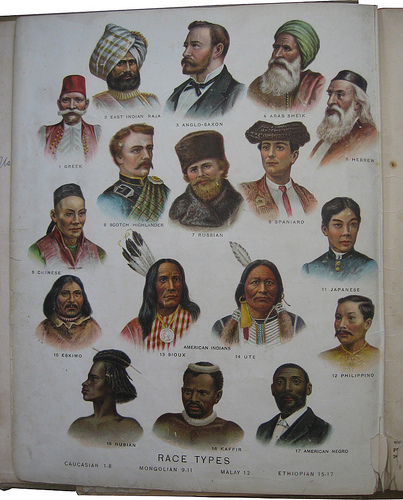
I’ve written before about our peculiar drive to separate the various races, ethnicities, and tribes that constitute the human kaleidoscope. I’m not talking about the cultural or social differences that make life interesting (indeed, that’s the whole point of this blog). I’m referring to the common perception that there is something fundamentally different, even wrong, with people who don’t share our skin color or eye shape or nose width or whatever.

Many people insist upon accenting these differences, as if they were truly meaningful. This is despite the fact that scientists say that any two humans have at least 99% of their DNA in common. That’s basic biology.

So I was intrigued to read about the “Faces of America” series on PBS. The creators of this show “used historical archives and cutting-edge genetic research to trace the ancestry of a dozen famous Americans.”

They found out, of course, that Americans are the ultimate immigrants, and that even random people of vastly different races have common ancestors. To drive home the point, the show profiles Americans of different ethnicities.

The Hispanic representative is actress Eva Longoria Parker. The show reveals that she is a distant cousin to cellist Yo-Yo Ma.

Their relationship does more than link the Latino and Asian cultures. It also does more than provide a funky six-degrees-of-celebrity anecdote.

The fact that Longoria Parker and Ma are cousins provides our missing link between high art and pop culture. Yes, their common ancestor passed down the talent to perform beautiful, complex musical passages of incredible intricacy. But he/she also bequeathed the ability to look hot while lounging courtside at LA Lakers games. We’re talking about a truly fascinating individual.

In any case, perhaps the best summation of the “Faces of America” project is from Henry Louis Gates (of the infamous Beer Summit, which I wrote about previously). Gates says, that when it comes to Americans, “We are all mulattos.”

It’s a good observation. And it is perhaps appropriate that he used a Spanish word to make his point.


Machinations Behind the Scenes

First, let me thank Louis for his comment on my post “Business Time.” Also, I’m pleased that Nellie found my post “Mazel Tov” to be relevant to her efforts to raise JewRican children. Check out her comment on that post; it’s most cool.

Next, I have to remind you that I occasionally take a break from posting new articles when something pressing comes up, be it a vacation or a move across country or an attack by Martians. None of those things are happening at the moment, but there’s still going to be a short gap between posts. I figure it will be a week, tops, so don’t abandon me for all those other cynical Latino bloggers you have bookmarked.

The reason for the brief hiatus is a combination of personal demands (I’ll be away from the computer for a few days) and the effort required to make improvements to this site. With hope, those improvements will be implemented soon, and they may surprise and delight you, or they could repulse and terrify you (by the way, that’s what we call a “teaser”).

To keep you entertained in the meantime, here is a video of my favorite breed of dog (a boxer) going crazy on a trampoline. Enjoy, and be sure to check back, because new updates will be coming soon.


Accent on the X

I don’t have an exact source for this one, a sloppy exception to my usual sterling journalistic standards. The factoid appeared in one of those guy magazines – “Maximum Details of Stuff,” something like that. I only browsed through it because I was stuck in the dentist’s waiting room, so give me a break.

In any case, the magazine polled its readers (all red-blooded American males) to find out what they think is the sexiest foreign accent. To my surprise, most guys said Spanish. I guess there’s something about trilled R’s and stressed “ch” sounds that drive men wild.

Now, although this information might make recent immigrants feel better about themselves, it has limited relevance to me. The poll doesn’t say which accent American women find sexiest (my guess is Italian), and in any case, I’m married and couldn’t use the advantage even if it were relevant to my speech patterns.

The poll results don’t even help the women in my family. Most of them were raised in the Midwest like me, and they speak English in a flat cadence that is far removed from the sultry drawl of a Salma Hayek.

But as nice as it is that Hispanics can win some kind of popularity contest (for once), and at the risk of offending those readers who have the sexiest accent in America, I must disagree with the poll results. I mean, come on, what’s hotter than a British accent?

Compare Rachel Weisz with our friend Salma, above.

See what I mean? I thought so.

But regardless of what verbal tones and inflictions you prefer, let me call a truce and wish everyone a happy Valentine’s Day. It’s the weekend for what we diplomatically call “romance,” but I think we all know what we’re really talking about. So stop reading this blog, grab your sweetie, and get to work.


Mazel Tov!

A few years ago, I took one of those internet quizzes that pinpoints your real religion, based on your actual beliefs and not the lip service that you espouse. Like all internet quizzes, I’m sure it was of dubious validity and reliability, and it probably had a questionable theological basis on top of that.

Still, I couldn’t argue with the result, which said that I was, in reality, a Reform Jew. By the way, the religion of my childhood, Roman Catholicism, ranked around twenty-eighth or so on my personal scale, which sounded about right (but I’ll refrain from picking on Catholicism just now).

These days, I consider myself more of secular Buddhist agnostic. But the Jewish angle isn’t that far off.

I’m not sure why I relate to Judaism. It’s not like I had a lot of Jewish friends growing up. My neighborhood was primarily Hispanic (and therefore, incredibly Catholic) while my home state is overwhelmingly Midwestern white (mostly Protestant). So not a lot of Goldbergs and Silvermans appeared on the scene.

Perhaps I picked it up when I lived in New York City, where Jewish culture is everywhere. Within just a few years of arriving in NYC, I was ordering bagels with lox and talking about people’s chutzpah and obsessing about death. So maybe that’s why I came up Jewish on the test.

But I think there’s a larger issue. It seems that Hispanics and Jews have always gotten along pretty well. Perhaps both groups know what it’s like to pass for white, but not really. Maybe our mutual focus on family lines up nicely. Or perhaps we just admire each culture’s long history of suffering.

Regardless, I was intrigued to read about a group of Hasidim Jews in Brooklyn’s Crown Heights neighborhood. A small but thriving population traces its ancestry to Spain and Latin America, and as such, members of this group consider themselves Hispanics.

Spare me your jokes about Juan Epstein, the NYC Puerto Rican Jew from “Welcome Back, Kotter.”

There’s a man in Crown Heights with a real-life cross-cultural headspinner of a name, Moshe Nunez, and he says that “There are a lot of Latin American Jews here…. Many non-Jewish Latinos are surprised to see Orthodox Jews in Brooklyn who speak Spanish and carry on their Hispanic traditions.”

I suppose that would be an attention-getting sight. But still, I’m not really shocked that some people would adopt both cultures. The overlap goes back decades.

For example, when my mother moved to America, back in the 1960s, her first job was helping out an old Jewish woman on Manhattan’s Upper East Side. The woman was a Holocaust survivor, and she brought that horrific period to life for my mother by rolling up her sleeve and showing the number branded into her arm. This simple display provided quite the education for a young woman from Latin America.

The old woman was very kind to my mother, and she introduced her to the opera and nice restaurants and the finer things in life. According to my mother, the old woman was adamant that bigotry against any group was evil. She said that anyone who would discriminate against a Latino would bash Jews as well.

In the old woman’s mind, we’re all one and the same.


  • Calendar

    April 2026
    M T W T F S S
     12345
    6789101112
    13141516171819
    20212223242526
    27282930  
  • Share this Blog

    Bookmark and Share
  • My Books

  • Barrio Imbroglio

  • The Bridge to Pandemonium

  • Zombie President

  • Feed the Monster Alphabet Soup

  • The Hispanic Fanatic

  • Copyright © 1996-2010 Hispanic Fanatic. All rights reserved.
    Theme by ACM | Powered by WordPress