Tag: population growth

Suburban Sprawl

By now, I’m sure you’ve heard about the Brown Invasion. No, I’m not talking about all those Latinos stealing our jobs, selling our kids drugs, and hooting at our wives.

Hey, that’s old news. Even right-wingers are tired of peddling such fictions.

I’m referring to the recent study that showed ethnic minorities are no longer content to live in barrios and inner cities. For example, “metropolitan New York is being rapidly reshaped as blacks, Latinos, Asians and immigrants surge into the suburbs.”

Yes, my friends, it’s a damn surge out there. Watch out, suburbia.

I used to live in NYC, and my neighborhood, although primarily white, was decently mixed. The same is true of the LA area in which I live now. It’s one reason that I’ve loved both neighborhoods.

However, I have never lived in a suburb, nor do I have any desire to do so. Every time I visit a friend who has bought a house on a cul-de-sac, I get a little jittery, like the 1950s are going to suddenly explode all over me. I expect to look over a manicured lawn and there, in the distance, see a nuclear family in black and white, playing croquet and drinking lemonade.

But that’s just my hang-up. As much as I love living in cities, it would be a sad commentary if every Hispanic thought exactly as I do. By all means, if the Rodriguez family wants to take the commuter rail, I say enjoy the ride.

Still, it’s not like Latinos are blending in effortlessly with their suburban compatriots. That old barrier — segregation — exists even when Hispanics leave the big bad city behind. Latinos tend to be “typically clustered in ethnically or racially monolithic communities,” even in suburbia. So Wally and the Beaver won’t necessarily be hanging with Juan and Maria.

But perhaps that’s in the future, and maybe there are other positive developments yet to come. For example, suburbanites may have more diversity at their key parties someday.

And perhaps the whole concept of suburban angst will have to be redefined. Maybe a couple named Hernandez will feel ennui for once.

This opens up exciting possibilities. Perhaps a Hispanic director will remake “American Beauty” or “The Ice Storm,” but with Latinos in the lead. And of course, maybe someone can take another shot at “Revolutionary Road.”

If so, can we talk Kate Winslet into playing a Latina?

Yes, I still have a monster crush on the woman; sue me.


Enclaves Everywhere

When I was a college student, I worked at the student newspaper. I was a longhaired, hard-drinking journalist — a Woodward and/or Bernstein in training — who would someday expose wrongdoers and bring down corrupt powerbrokers.

Well, at least that’s how I saw myself back then. It didn’t quite work out that way. And it’s not just because my chosen field, print journalism, soon became as relevant as the telegraph.

In truth, I got soured on the crusading-reporter thing pretty quickly. One of my first interview subjects was an intense man who proudly called himself a black separatist. He gave lectures around the country that outlined how African Americans needed to reject integration and establish their own nation.

To continue reading this post, please click here.


The Latino Side of Town

I grew up in a state that was overwhelming white, in a city that was somewhat white, in a neighborhood that was barely white. The de facto segregation in my hometown meant that whole sections of the city could easily be identified as the barrio or the black neighborhood or the fledgling Asian district. It was geographically convenient to pinpoint where the white people weren’t, because they were so plentiful everywhere else.

But in the United States of 2011, it’s not so simple. According to the U.S. Census Bureau, “America’s neighborhoods became more integrated last year than during any time in at least a century.” This of course means we’ve achieved the mythical color-blind society where racism and ethnic conflict have been banished forever… well, not really.

To continue reading this post, please click here.


Now I’m Glad We Didn’t Skip It

About a year ago, I wrote about the bizarre attempt by some Latino organizations to boycott the U.S. Census. As far as I know, this baffling protest never took off.

As a result, Census numbers continue to trickle in, and they offer the occasionally intriguing, often disturbing look at the state of Hispanics in America. Yes, we have fresh proof that Latinos are the fastest growing demographic, but come on; you know that one already.

But were you aware that Latinos are the most likely group to not have any health insurance (32.4 percent of all Hispanics)? Well, in that case, it’s a damn good thing I’m here to pass along these Census statistics to you, isn’t it?

Now, some of the numbers are more official than others. A few offer only a snapshot of 2010 or even 2009. But all of them are as accurate and precise as government bureaucracies can get.

The most alarming of these figures is the fact that more than a quarter of Latinos (25.4 percent) live in poverty. This compares to an overall poverty rate of 14.5 percent, and is more than double the rate for whites and Asians. But it’s still less than blacks and Native Americans (who “win” this category with a rate of 27.7 percent).

Put another way — and Census numbers are all about putting things another way — the median household income for Latinos was just 70 percent of that for whites. The lack of take-home pay is no doubt because Latinos have an unemployment rate of 12.9 percent, far higher than whites (8.7 percent) and Asian Americans (7.3 percent).

Those grotesque figures would be even more dismal if Puerto Rico, hit hard by the recession, was included in the analysis. Because it’s not a state, the island gets its own set of numbers — including the wacky stat that “massive emigration to the United States and the reduction in birth rate have caused a drop of 2.2% in the population of Puerto Rico.” Apparently, there’s a stampede of Puerto Ricans into the mainland, but that’s a whole other post.

Of course, numbers don’t tell the whole story. The Center for American Progress breaks down these figures by saying, “racial and ethnic differences have worsened or stayed the same during the recession and recovery.” These killjoys point out that unemployment and poverty rates rose for Hispanics, while health insurance coverage, retirement savings, and homeownership rates all fell.

In fact, the Center says that “Latino homeownership rates in 2010 … were again close to their levels in 2001 even though Latino homeownership rates had risen from 2000 to 2007.” But I’m going to call my bad on that one. I contributed to the statistics by buying a house in 2004 and selling it in 2009 (no, the bank didn’t foreclose on us).

In sum, the Census numbers “show widening gaps by race and ethnicity throughout the recession and recovery.” The best we can hope for is that the 2020 Census reveals more uplifting news — unless we boycott that one.


The Numbers Are In

Let’s start this New Year with some quick facts, courtesy of the 2010 U.S. Census:

  • The resident population of the United States is now 308,745,558, a 9.7 percent increase over 2000
  • Latino population growth for the decade was around 29 percent
  • Non-Latino population growth was about 4 percent
  • The fastest-growing states were generally states with large Latino populations

At the great risk of pointing out the obvious, it’s clear that Hispanics are a big reason that this country is growing at all. Keep in mind that immigration, both legal and illegal, has been declining ever since the Great Recession began, which means that Latino population growth would be even greater if not for the quirky anomaly of a total economic collapse.

So Latinos are driving America’s growth. Depending on your perspective, this is either a positive development for multiculturalism or the final stage of the dreaded Brown Invasion.

One thing that it indisputably means, however, is that Hispanic influence — on everything from political movements to pop culture events — will only increase in the new decade.

It may also mean the death of a particularly pernicious tactic: Scapegoating Hispanics for America’s ills.

But hatred is a strong and insatiable monster, and as Angelo Falcon, president of the National Institute for Latino Policy, has stated, “Turning our population numbers into political and economic power is not an automatic or simple thing to accomplish.”

So expect the fear-mongering to go on for a while, even as Latinos become more numerous, and we segue from exotic pioneers to next-door neighbors.

By the way, the U.S. population grew at its lowest rate since the Great Depression. So without Hispanics, the United States would be in danger of becoming one of those teetering industrial nations, like Japan or Italy, where stagnant growth is causing widespread concern about the future. That’s not really the case here.

You’re welcome, America.


I Just May Live Forever

Here’s a quick thanks to Festina, Juan, Jenn, Millie, and the always amazing Ankhesen Mie for their recent comments on my posts. Also, thanks to Pete for commenting on my post about wine tasting… which reminds me.

As I’m sure you’ve heard, people who drink wine tend to be healthier than abstainers. This means that I am encroaching on invincibility, because in addition to my love of vino, I am most positively Hispanic.

Yes, on the heels of the Immigrant Paradox, we have the even more perplexing and intriguing Latino Paradox. It sounds all twisty and stuff, doesn’t it?

This term describes “the surprising health of Latinos in the United States” who “are less likely to have health insurance … go to doctors less often and receive less in the way of hospitalization or high-level care when they are sick. Yet they … have lower rates of heart disease, cancer and stroke.”

For some reason that doctors, researchers, and healthcare experts can’t explain, we Hispanics are generally healthier and tend to live longer than our white or black brothers and sisters. On a purely anecdotal level, I can back this up.

My grandmother is pushing ninety and suffers fewer physical ailments than some people half her age. Indeed, members of my family usually have long lives, as long as they don’t get shot (but that’s another topic).

So what is the basis for the Latino Paradox? Well, among the guesses are concepts that I’ve discussed before, such as the fact that “Latino culture is particularly family-oriented; there also are strong community and neighborhood networks.” In addition, we Hispanics “eat somewhat more healthfully, with higher consumption of fruits and vegetables” despite the fact that “white adults know more about nutrition than Latino adults.”

To really pile it on, the stats show that “pregnant Latino women are less likely to smoke, drink alcohol, use drugs or have sexually transmitted diseases than American women as a whole,” which probably explains our “lower infant mortality rates, and quite probably health later in life.”

Clearly, we Hispanics are one beneficial gene mutation away from becoming completely bulletproof.

But it’s not all good news. And as I’ve written before, getting Hispanics to have regular medical checkups can be a challenge. Furthermore, the researchers found that “although Latino children who immigrate to the U.S. with their parents have lower rates of obesity than their U.S.-born peers, their risk of obesity increases the longer they live here.”

In other words, the more time Hispanics spend in the United States, the more likely they are to become fat, sedentary, and artery-clogged Americans. The Latino Paradox holds that “acculturation to the American way of life may worsen the health of Latinos, especially when combined with lack of access to medical care.”

As such, the lesson of the Latino Paradox is obvious.

I hate to break it to certain political leaders, but if we really want to reduce the cost of healthcare, and help Americans of every race to live longer while we’re at it, it’s clear what we have to do:

Everybody has to become a little more Hispanic.


Gimme a Shot of Cabernet

I’ve mentioned before that one of my vices is alcohol, specifically wine. And yes, people in wine shops are not always delighted to see me.

In any case, I’ve also mentioned that my wife and I like to go wine-tasting, which is about as “boogee” (as Cousin #1 would say) as it gets. I mean, it’s not exactly keeping it real in the barrio to say things like, “The tannins on this zinfandel give way to notes of chocolate.”

But as I‘ve also stated, a person can get drive himself insane by measuring every decision or preference against the ever-shifting and amorphous concept of “authenticity.”

So I’m not going to apologize for the fact that we like zipping through the California countryside and sampling the vineyards’ vino.

When we first started doing this, my wife and I were among the few Gen Xers who showed up in the tasting room. Lately, however, we’ve noticed that more people are our age. Perhaps it is a truism that individuals develop more sophisticated palates and upscale tastes as they get older. Or maybe my peers have realized how depressing keggers are when you’re pushing forty.

Regardless, I’ve also noticed that I’m no longer the sole Latino at such functions. In the past, the only Hispanics I ever saw were the laborers in the fields. Indeed, this agricultural industry is one of the top employers of Latinos, and several Hispanics have worked their way up to management or even ownership positions — something highly rare in corporate America.

In the tasting room, however, it’s still been mostly white people — at least until lately. So what should I make, if anything, of the observation that more Latinos are joining me in swirling around a glass of syrah?

It’s probably nothing more profound than the fact that, even in these horrific economic times, the demographic shift underway in America continues. And it won’t be long before every aspect of upscale U.S. culture — from country clubs to executive boardrooms — gets an ethnic makeover. It is inevitable.

However, it also means that whenever Hollywood gets around to remaking Sideways (every movie get remade, sooner or later), they will probably replace Paul Giamatti with someone who is, shall we say, a little swarthier.


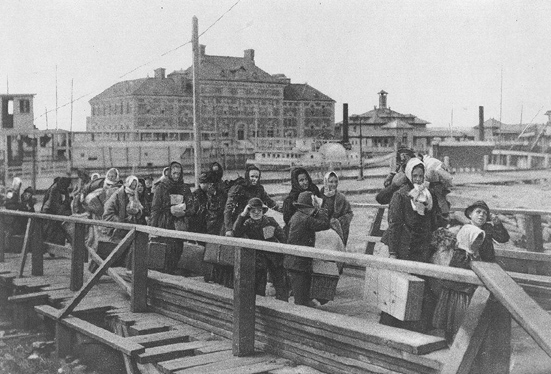
Ellis Island Is Now a Museum

We often hear that the United States is a nation of immigrants. The occasional subtext behind this statement, however, is that European settlers founded this country, and that their contemporary descendants are the rightful owners of this land (i.e., the “real” Americans). As such, any other kind of immigrant is bothersome, or even menacing.

However, the U.S. Census Bureau recently revealed that a lot of us hanging out in these amber fields of grain have solid roots in other lands. Approximately 36.7 million of the nation’s population (12 percent) were born in foreign countries. About 33 million (11 percent) are native-born with at least one foreign-born parent.

This means that about 23 percent of the U.S. population (including your most humble blogger) are first-generation Americans or immigrants. As such, it is clear that the immigrant experience — long celebrated so long as the story stopped circa 1920 — is still an ongoing saga.

To continue reading this post, please click here.


Meet the New Boss?

Over the years, I’ve received readers’ comments that range from astute to insane. The thoughtful, the witty, the shrill, and the easily offended have all sent me missives. Both praise and damnation have hit my inbox.

However, only a few comments have prompted me to write a whole post in reply. That short list just got lengthened.

To continue reading this post, please click here.


Believe

Now would be the perfect time for me to find religion. As I’ve stated in previous posts, my recent downsizing has put me in a pissed-off mood that would likely be alleviated from the comfort that faith provides.

But it’s just not taking.

I’ve written about it before, but I’ll state it again. There is no kind of bitter ex-Catholic like a bitter Latino ex-Catholic. I spent the first twenty or so years of my life obsessing on God, and now I am spending the ensuing decades obsessing on how religion is messing up the world.

As you can see, Hispanics are not casually Catholic. You are either into it, or you recoil from it. The whole concept of being laidback about religion is alien to most Latinos.

My wife, who was raised Methodist, doesn’t share my preoccupation with religious dogma or interest in Dante’s “Inferno” or creeping fear that “The Exorcist” was actually a documentary. She is far healthier in her relationship to religion.

As a child, I skipped Mass just once. I had the flu that day, and as I sat on the couch hoping that God didn’t strike me down for missing church, I stared at the television in disbelief. Programs continued to play on TV, even during the time that we were supposed to be in church. I had always assumed that the television went off the air from 11:00 am to noon because, after all, nobody was watching because they were all in the pews. My mother had to explain to me that some people did not go to Mass, and I found this more shocking than discovering there is no Santa Claus. She was talking crazy. Who didn’t go to church?

This is not to say that I blame my mother for my upbringing. In fact, she showed the kind of trust and parental responsibility that more adults should display.

When I was sixteen, it was time for me to sign up for confirmation classes. Presented with this opportunity, I took a moment to deliberate and then, as if I were choosing chocolate over vanilla, I told my mother that I didn’t want to be confirmed.

“Why?” she asked.

“I just don’t believe it,” I said.

She nodded and said, “No one can make you believe anything. If you don’t want to do it, then you shouldn’t do it.”

I didn’t recognize the magnitude of her support until later years, when even the most ardent atheistic of my friends admitted that they had been forcefully confirmed in the church of their parents’ choosing. My mother had the right idea: If you don’t believe it, move on.

No, I don’t hate the Catholic Church. Rather, like many Hispanics, being raised Catholic has left me with a spiritual nagging that forces me to ponder the big questions, fruitlessly, when all I really want to do is analyze the odds of my team making the World Series (by the way, those odds could be better).

Neither am I an atheist. It is far too definitive of an answer for me, so clear and simple in its certainty that I have to be skeptical of it. If forced to describe myself, I go with “secular Buddhist agnostic,” and this mish-mash appears to suffice. Or perhaps I am a rationalist like Bill Maher, he of the biting wit and self-satisfied smirk.

Still, the fact that I even address Catholicism in these posts is telling. I can’t seem to let it go.

Of course, there are reasons beyond my own neurosis to revisit this topic. The interplay between Christianity and Hispanic culture has larger societal ramifications.

For example, as I mentioned in a previous post, younger Hispanics are turning away from the Church. What does this mean to the future of Latino culture? Will it be less Catholic, or are these norms so ingrained that there is no altering them, regardless of their direct relevance to the latest generation?

Going further, one could also ask what this means to a country that is, like it or not, getting more Latino. Will this have an impact on, for example, the scary stat that just 39 percent of Americans believe in evolution?

By the way, let’s set aside the point that a better way to phrase the question is, “Do you understand evolution?” rather than making scientific fact a question of belief.

In any case, I don’t know if the poll results are broken down by ethnicity, but I have to assume that several Hispanic Catholics continue to distrust Darwin, even if the Church (to its credit) has said that the theory of evolution is not a threat to spirituality. Will Hispanics still be weary of science in another decade?

If so, it makes me want to cross myself and say a Hail Mary.


  • Calendar

    April 2026
    M T W T F S S
     12345
    6789101112
    13141516171819
    20212223242526
    27282930  
  • Share this Blog

    Bookmark and Share
  • My Books

  • Barrio Imbroglio

  • The Bridge to Pandemonium

  • Zombie President

  • Feed the Monster Alphabet Soup

  • The Hispanic Fanatic

  • Copyright © 1996-2010 Hispanic Fanatic. All rights reserved.
    Theme by ACM | Powered by WordPress