I’ve written before about the demographic change taking place in America. Specifically, ethnic minorities, led by Latinos, are reproducing at a faster pace than white Americans are. As such, in the near future, the United States will be a minority-majority country.
This has caused much teeth gnashing and wailing among overt racists, of course. But many other people who deny prejudice or ethnic animosity have also expressed their concern. Their deep-seeded fear, masked as logical concern, is that Latino teenagers have the highest dropout rate of any ethnic group. As such, they’re afraid that at some point, a legion of uneducated Hispanics will take over the nation and send us into an abyss.
Their solution – let’s try to kick out as many Latinos as we can now – is bigoted of course. But more than that, it’s impractical. No matter what they do, white people will one day be, if not minorities themselves, no more than a plurality.
One would think, therefore, that instead of simply bemoaning the fact that too many Hispanic teens aren’t finishing school, the majority culture would strive to make sure that the largest subgroup of younger Americans will be better educated.
Hispanics are used to being insulted and denigrated. After all, there are a wide variety of colorful slurs and cultural putdowns from which the bigot can choose.
However, “lazy” has never seemed to stick. When it is applied to us, it seems to tumble out in an almost haphazard way. It’s as if the racist doesn’t really believe it, and is just hurling epithets that sound good. After all, how can Latinos be lazy if they’re working hard to invade America and then steal everybody’s job? That sounds like quite a strenuous chore to me.
The stereotype of the shiftless Latino pinnacled back in the days when welfare cheats were the biggest boogieman that white America had to face. Even then, it was scarier to paint African Americans as lazy. That imagery still resonates with true haters. After all, Hispanics don’t have a Stepin Fetchit as cultural shorthand.
In recent years, the claim that Hispanics are lazy has been further diminished. The cliché of the sweaty Latino knocking himself out to install your roof or finish your garden or clean your hotel room has come to the fore.
I’m so horribly, terribly angry about how the U.S. team was robbed in their World Cup match against… who was it again? Um, I’m going to guess… Canada? No, it was Belgium, right?
Never mind, I can’t carry on this charade anymore. The truth is that I could not care less about the World Cup. I’ve never been a soccer fan, and that doesn’t change whenever this mega-event comes around.
But saying that I’m indifferent to soccer is likely to provoke judgment and scorn, which is a complete 180 from a generation ago, when only freaks and outcasts acknowledged an interest in the sport. This is because in the multicultural, global-village world in which we now live, many Americans are eager to prove their international bona fides.
As such, dismissing soccer is like saying you don’t like sushi, or have never seen a French movie. The person who has enjoyed those things may smirk and say, “How very American of you” and dismiss you as a parochial ignoramus.
Of course, many Americans really are parochial ignoramuses, but that’s another post.
In any case, the World Cup carries an extra burden for American Hispanics. After all, soccer is ridiculously popular in Latin America. Furthermore, the World Cup is a time for immigrants and their first-generation offspring to bond and root for the mother country.
However, I just can’t get into it – not because I think soccer is stupid or boring. Indeed, I will watch the whole damn series rather than sit through five minutes of a golf tournament. But the sport has never resonated with me, which puts me on the defensive.
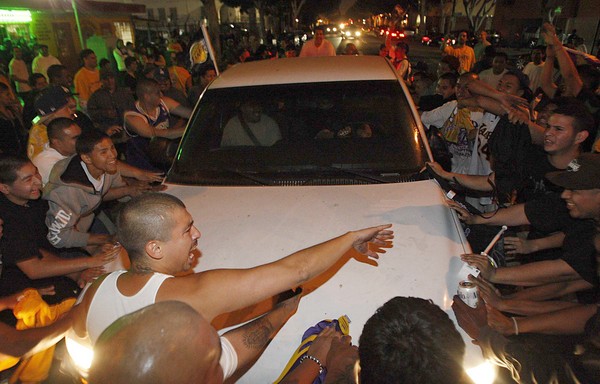
For the record, I’m not big on basketball either, although I thought it was nice that my local Lakers won. Well, I did think it was good news, until I saw how certain people celebrated downtown.
Yes, it was a good old-fashioned LA sports riot. Fortunately, no one was killed, and the destruction and number of injuries were not as bad as some other outbreaks of this type.
Still, the violence brought out the worst elements in American culture, and I’m not just talking about the thugs who took to the streets. Internet commentary is blistering with accusations of illegal immigrants torching LA and Hispanics on welfare who look for any reason to riot and wetbacks running around out of control and… well, you get the picture.
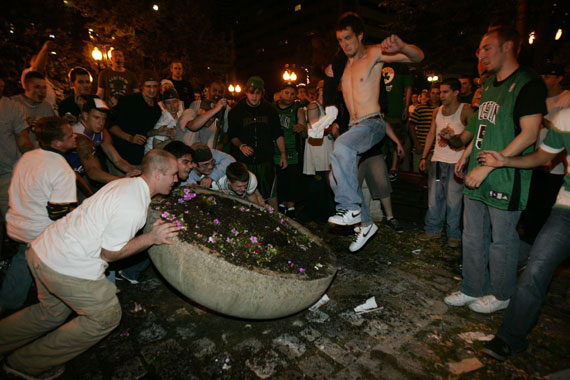
A few hoodlums pounce on an opportunity to wreck havoc, and many Americans are only too happy to paint it as an essential trait of all Hispanics. I suppose I should point out that riots happen all over the world over sporting events. For example, when the Celtics won the championship recently, a similar scene occurred.
It doesn’t look like many Hispanics were involved in that one, but I’m sure we got blamed.
There was even rioting in Montreal over a recent hockey game. Think about that: the most polite people in the world freaked out over a sporting event! And nary a Latino was to be found on the scene.
Yes, the way Americans (and apparently, Canadians) celebrate their team’s victories is depressing. Perhaps I need to reassess this soccer thing. Maybe I should get into this more civilized display of athletic competition.
Hey, maybe I’ll root for Scotland. I hear that they don’t have any hooligan fans.
I want to thank Chris, Rose, and Ankhesen Mie for their recent comments, as well as everyone who responded to my most recent article for the Huffington Post. The 160 or so comments I got on HuffPo are the most I’ve received for one article. And only a few people there were nuts and/or unruly.
That post, of course, was about the shooting death of a teenager, which clearly is a depressing topic. So these days, I’m looking for a sliver of optimism out there. I may have found it.
Now, I’ve written before that I’m a fan of PostSecret. This is despite the fact that too many of the secrets are actually just sappy affirmations. And I also think it’s odd that the creator of the site includes at least one image of a female breast in every week’s batch (that’s not a criticism; just an observation).
In any case, PostSecret may have achieved a goal that all we bloggers have, which is to save a life. This accomplishment has, for some reason, eluded me on this site.
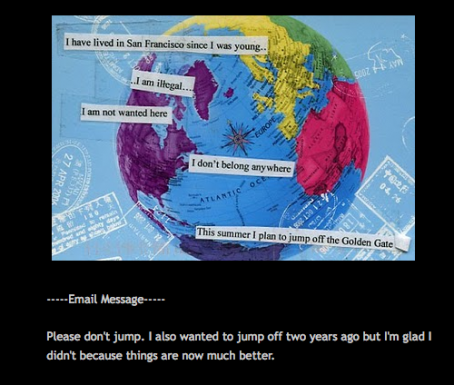
But PostSecret may have done it. A few weeks ago, the site ran the following:
Yes, for some inexplicable reason, the illegal immigrant who made this card feels that Americans would be happier if he just dropped dead. I don’t know where he got that idea… unless it was the nonstop barrage of right-wing media outlets blaming the undocumented for everything from the economic collapse to imaginary crime waves, with rage-filled commentary that implied individuals without papers are less than human.
But really, I’m sure that had nothing to do with it.
So did the illegal immigrant jump to his or her death? No one knows.
With hope, however, this person saw the response that the secret provoked, and maybe this changed his or her mind.
“Time” magazine reports that, because of the postcard, “within 24 hours, nearly 20,000 people had signed up for a Facebook group titled ‘Please don’t jump,’ which was … linking in thousands of supportive comments.”
PostSecret adds that in the week since the secret was posted, “over 50,000 of you joined an online community offering encouragement and help” and that earlier this week, “hundreds are meeting on the Golden Gate Bridge to take a stand against suicide.”
I have to admit that this is quite a showing of support for one scared illegal immigrant. The outcome serves as a much-needed antidote to the hateful comments about the shooting death of Sergio Adrian Hernandez Guereca (again, see my previous post).
Does this mean that there is still a kernel of compassion left in the increasingly jingoistic American soul? Is it possible that many people see the undocumented as fully human rather than as pests to be exterminated?
I moved back to Los Angeles about six months ago. In the half year that I’ve been back, I’ve been most grateful to see old friends, to discover great places and events that sprung up in my absence, and to skip winter altogether.
But I’m also happy that my return to California has had a positive effect on this blog. In my previous hometown in the Midwest, Hispanics are still a fairly rare sight, so Latino-themed stories don’t pop up too often. But in LA, every other newsmaker has a name that ends in Z, or some debate gets going about clashing cultures, or there’s a new Hispanic-influenced restaurant, art form, or social movement taking hold.
For example, the Catholic Church recently named a new leader of the Los Angeles diocese, which has the largest concentration of Catholics in America. Archbishop Jose Gomez is now “in line to become the highest-ranking Latino in the American Catholic hierarchy and the first Latino cardinal in the U.S.”
His predecessor, Cardinal Roger Mahony, said he was “grateful to God for this gift of a Hispanic archbishop” and said he personally asked the pope to supply him with a Latino replacement. Los Angeles has five million Catholics, over 70 percent of whom are Hispanic, so Gomez’s appointment couldn’t have been too much of a shocker. Even so, Mahony’s sentiments – thanking God for a Latino and pressing to replaced by a Hispanic – are somewhat rare occurrences in the United States, as I’m sure you can imagine. But it happens here in California.
By the way, Gomez was a member of Opus Dei, which according to several conspiracy theorists and best-selling authors, is really just a front for power-hungry zealots, albino assassins, and killer dwarves. If true, it could make the line for communion very interesting.
Another only-in-LA moment came when I saw the poster for an upcoming Cinco de Mayo celebration. But this was not some bland, half-assed get-together with cheap tequila shooters, which you might find in other parts of the country. No, this party (called Cinco de Mayan), features “mucho sexo y violencia in the form of burlesque dancers, masked Mexican wrestlers, comedians, mariachi, Aztec dancers, and more.”
To be honest, I have no plans to attend this event. But just knowing that it exists here makes me smile.
Still, it’s not just traditionalist priests and masked wrestlers who get noticed in California. As the LA Times points out, Hispanic influence is part of an accelerating trend in this city, as “the power positions held by Latinos in the Los Angeles area are multiple and manifest. Besides the Mexico-born archbishop… there is the mayor. The speaker of the Assembly. The sheriff. A county supervisor. Several members of the City Council, of Congress, of the Legislature, of the Los Angeles school board…. All told, the taking of power has been stunning in its breadth.”
And that power can resonate beyond Latinos. This brings me to one more tidbit that made me happy to be in California. A UCLA professor, Don Nakanishi, is leading a movement to make East LA, which is 97% Latino, a separate city. I don’t agree with his position, but I have to respect his goals. I especially liked his comments about becoming politicized as a young man.
In college, Nakanishi “joined ten Latinos in forming a group called Los Hermanos, Spanish for ‘the brothers’.” He later formed an Asian American student group and said of the process, “We learned from the Chicanos.”
In a recent post, I expressed my admiration for the British accent. I said that it was pretty damn sexy, at least on women. I can’t judge if it’s sexy on guys (one of you ladies or gay men will have to inform me). But I will admit that British men sound more sophisticated and intelligent than we who have been afflicted with the flat American way of speaking.
And of course, anything witty sounds twice as funny with a crisp English accent.
I presume that many Americans share my belief in the inherent coolness of these island dwellers. But for a Latino, this fascination is an extra burden. It comes across as self-loathing or pathetic.
For the record, I’ve never been ashamed of being Hispanic. Nor have I ever wished that I could magically turn white or become black or pass for Asian (although many people assume that I’m Japanese, as I wrote here).
But I have to admit, part of me would like to do life all over as a British guy. Those cheeky bastards have a hold on me.
The chief cultural influence on my sense of humor is Monty Python. My favorite band is Led Zeppelin. I think the Union Jack is the greatest flag design ever.
My god, Great Britain is everywhere in my head.
Perhaps this explains my running jokes about having an unhealthy obsession with Kate Winslet (my sympathies on her recent divorce, but I can’t understand why she is still not returning my phone calls). And maybe this is why I’ve spent my professional life focusing on the English language. Hell, maybe this is why I’ve had so many problems with my teeth (I’m not at British level in that regard, however).
I’ve written before about feeling a kinship with Jews. That’s true. But if I were not a proud American Latino, I would adopt an English persona. And I’m sure that many of you – whether white, black, Asian, or a fellow Hispanic – agree that it would be most cool to issue snide asides with flair and take the tube to Piccadilly Circus and complain about the bloody weather and keep a stiff upper lip and all of that.
My wife and I travelled to London once. We still talk about ditching it all and moving there someday. This is usually after a few drinks and/or a Republican political victory. In any case, don’t hold your breath, because we both agree that we would miss America too much to adopt the expatriate life (by the way, would I be considered an expat or an immigrant?).
Still, before I glamorize the British even more than I have, I will bring these smart, sexy, clever people back down to earth:
Their food really sucks.
There, I said it. It’s a cheap shot, I know, but at the moment, it’s all I’ve got.
In an earlier post, I wrote about my experiences as one of the few Latinos on my college campus, back in the day. At that time, the percentage of Hispanics at my alma mater was less than two percent.
In the years since, it has gone up, which is part of a larger, welcoming trend. Although Hispanics continue to be rare sight on American campuses, the number of young Latinos who are giving it the old college try is on the upswing. Some estimates say that about 12 percent of college students are Hispanic, which isn’t far off our proportion in the general population (currently at 15 percent and rising).
Furthermore, according to the U.S. Department of Education, 27 percent of Latinos ages 18 to 24 are enrolled in college. That’s apparently the highest the number has ever been, although it still pales in comparison to the percentage of young whites (43 percent) and blacks (33 percent). I don’t know the percentage of young Asian Americans in school, but let’s face it, I’m sure it’s impressive.
So more Hispanics are signing on for student debt and hitting on sorority girls and drinking too much on Thursday nights and living in shitty apartments with roommates who have loud sex with strangers in your bed… Sorry, I got a little nostalgic there.
One reason for the increase in Latino attendance is simple demographics. As Hispanics continue to assimilate into the general population (and assimilation is indeed underway, regardless of what you’ve heard on talk radio), they are more likely to adopt the cultural advantages of the majority. The chance to attend college, of course, is one of the biggest pluses of being American.
A lot of young Latinos see higher education as a natural extension, or as a clear benefit to their lives. Previous generations, including my own, were more likely to view going to a university as something for rich white kids, or as a laughable proposition that they were foolish for even considering.
When I was younger, several of my Latino peers even proclaimed that it was “selling out” to move past the twelfth grade. The implication was that choosing ignorance and poverty was a noble cause for La Raza. Today’s generation of young Latinos is far more likely to view this sad justification as the self-defeating prophesy that it is.
Another factor for increased Hispanic attendance is that major universities are more likely to actively recruit young Latinos. This is primarily because society has become more accepting of the idea that not everybody is white (well, most of America has, at least). But it’s also simple economics. A larger percentage of young people today are Latinos. As I’ve written many times before, Hispanics are the fastest-growing segment of the population. Therefore, if colleges want to continue to get students to fork over tuition, they must reach out to Latinos.
I’ll just mention that when I was eighteen and trying to pick a school, most universities’ minority outreach consisted of mailing out a pamphlet on the importance of diversity. And most of the time, all the pictures were of black people.
The fact that more Latinos are attending college offers one final interesting factoid. Hispanics who attend universities are now more likely to actually go away to college, as their white and black peers do, than they were in the past. According to the LA Times, “since 1975, the share of Latino freshmen at four-year colleges who choose schools more than fifty miles from home has risen to nearly 59% from about 46%.”
Of course, leaving one’s family provokes conflicting feelings within Latinos. Because many of us are first-generation, we can still access our parents’ immigrant roots. We can comprehend travelling great distances to start new lives.
However, the tight bonds of the traditional Hispanic family often clash with the individual’s need for fulfillment. At such times, will the biggest obstacle to a Latino going away to college be a guilt-tripping father or a perplexed abuela or a needy cousin?
It’s difficult to say. But I’m sure that for many of next year’s Latino college freshman, calling mom every day will be a top priority.
Here’s a quick shout out to Frankie, Ankhesen, Ulises, and Chris for their comments on my recent posts. Thank you all, and thanks to everyone who shares his or her thoughts here.
But now let me backtrack a little.
Recently, I used my cyber bully pulpit to disparage comedian George Lopez and, by extension, anyone who thinks that he’s funny. I’m not backing down on my criticism, but I need to qualify it.
You see, I’ve written much about the positive aspects of Latino culture, such as our strong familial ties and powerful work ethic and openness to share emotions and many other good and true characteristics.
But I’ve also written about some less uplifting traits. And to that list, I have to add one more item:
We’re not particularly funny people.
I realize this is a gross generalization. I’m sure that plenty of Latinos are hilarious. It’s just that I haven’t met them or seen them on television or watched their stand-up routines.
We have to be honest and say that no Hispanic has ever really made America laugh, except maybe Cheech Marin, and he put the low in low-brow.
Indeed, the first Hispanic sitcom, back in the 1980s, was “Aka Pablo,” starring Paul Rodriguez. It was such a monumental flop that Latinos have been rare on comedies ever since (by the way, my hatred for this short-lived show is so intense that it demands a full post sometime).
The first Hispanic comedian to receive any kind of mainstream success in America was Cantinflas, a star from the 1950s. You are forgiven if you don’t know who he is. The guy seems to be more of poor man’s Charlie Chaplin than anything else.
One could argue that Latino culture’s history of death, destruction, and poverty does not lend itself to big laughs. That may be true, but then what do we make of the fact that some of the most insightful and cutting comedians of the last few decades have been black? Think of the line from Richard Pryor to Chris Rock and beyond. African Americans, of course, have just as much, if not more, misery in their collective backgrounds. They have apparently been better able to mine this history to create cutting-edge observations.
As a result, black people have Dave Chappelle. We have Carlos Mencia. That contrast is just depressing.
Similarly, a look at Jewish comedy reveals such heavy hitters as Woody Allen, Jerry Seinfeld, Judd Apatow, and others too numerous to mention. We’re talking about decades of mainstream success across a wide range of styles. And of course, Jews have endured one or two negative developments over the course of their cultural history. It hasn’t stopped them from coming up with a witty line now and then.
So why aren’t we funnier? I haven’t the slightest idea. But with this blog, I’ve tried to avoid becoming a writer who is, in the words of the great humorist Spalding Gray, so very “earnest, earnest, earnest.” That seems to be the default setting for many Latinos (and many bloggers, while we’re at it). By the way, Spalding Gray was a white guy.
In any case, the situation for Latino humor is grim… hey, I guess that was a joke, given the subject matter.
Yes, as you can see, you don’t want me to accept the challenge to be the comedic Latino. I’m just not that funny.
Like many people, I check out PostSecret weekly to see what kind of freaks, weirdoes, and social deviants are out there. For those of you who don’t know, PostSecret is a wildly successful website where people send in postcards detailing their dark secrets, obsessive thoughts, and big regrets.
The site is designed to bring us together, an online therapeutic effort to help people see that others share their fears and hopes. I’m sure it does that for many readers. But I imagine that for many others, it just provokes a voyeuristic “Wow, that guy is nuts” reaction.
Every now and then, I read a submission that resonates with me. For example, the following was in this week’s batch of new secrets:
I must admit that I’m annoyed. Sure, it’s offensive that somebody believes that a violent act is representative of Latino culture. And yes, it’s an odd and pathetic response for a victim to dwell on the mugger’s race (to the point of becoming “obsessed”).
But what really pisses me off is this: I’ve spent a lot of time writing about Latino culture, trying to express the nuances and intricacies of Hispanic thinking, when all I really had to do in order to get someone’s attention was to punch him and steal his wallet. That would have been substantially easier (and while we’re at, much more profitable).
So I’m sure you understand why I will refrain from any further efforts to publicize this blog via social media, google analytics, keywords, SEO marketing, word of mouth, or other techniques that are oh so inside-the-box thinking. I will also pay substantially less attention to quality writing and original insights, because that clearly doesn’t matter much.
Instead, you will find me wandering the alleys and badly lit streets of America, ready to pop someone on the head and then mention, while I’m counting their cash, that I’m Latino. That should get them good and interested in Hispanic culture.
By the way, one interesting thing about PostSecret is that the site doesn’t accept advertising. They’re actually a little smug about it. Of course, this blog has been ad-free from the beginning, so who could blame me if I finally wised up and added a couple of revenue enhancers? That’s just conjecture, of course, because any ads you see here will just be figments of your imagination…
First, let me thank everyone who has commented on my recent posts. I’m extending a big shout out to Pipil, Jeremy, Emma, AnaRC, Bugys, Jose, and Macon D. Keep those cards and letters coming!
Second, at the risk of trying your patience, I have one more thought about my recent move to Los Angeles. As I wrote, the movers who took our stuff to California were Latino. I wrote about how they arrived late at every stage of the process, but I didn’t say why.
Well, the reason is simple: They were on Hispanic time. As such, they were incapable of being punctual.
It is a cultural trademark of Latinos that we run late, or flake on deadlines, or just wander in at some point during the party. I’ve heard many reasons for this. Perhaps it is the laidback culture of the siesta that carried over to America. Maybe we don’t sweat the small stuff, and therefore refuse to obsess about what the clock says. Or perhaps we’re prone to some kind of time-space dyslexia that causes us to proclaim, “It’s only two minutes away” when the destination is in another city.
All I know is that every clock in my mother’s house is set fast. I am not exaggerating. My mom claims that this forces her to pick up the pace, because it tricks into thinking that she’s even later than she actually is. It works to some degree, because she tends to run less behind schedule than she did in the past.
For example, when I was in high school (and before I got my drivers license), I racked up myriad detentions because I had to rely on my mom to get me there. Every morning we rushed out the door as if the starting time for school had been cruelly moved up without notice. I protested to my teachers that arriving late was out of my control, but they insisted that I was consistently tardy because of adolescent belligerence rather than cultural norm. Then I got slapped with another detention.
In my family, I developed a reputation for being the only one who is ever on time. Perhaps it’s because I’m half-white. More likely, I just got frustrated at everyone always being late and tried to make up for it singlehandedly. My efforts have served only to increase my blood pressure.
Look no further than the Christmas Eve celebrations at my mom’s house, which start promptly at 4:00… or 5:00… or 6:00… or whenever everyone shows up. But my family always arrives, and we have a great time. Being late is difficult when nobody has bothered to set a time to meet in the first place, but we manage it.
I know other cultures claim that they have this affliction. I’ve heard of Arab time and Greek time. I’m sure they’re telling the truth. But honestly, I doubt they’re much competition when it comes to the utter lack of temporal awareness. Hispanic time is another animal altogether.
Still, if we must have some cultural issue with punctuality, we should try to make it more interesting. If we were exactly forty-three minutes and nineteen seconds late for everything, then we’d have something quirky. Instead, we’re just the tardy ones.
But again, why are we so perpetually behind schedule? What possible reason can there be for the fact that we Latinos take time so frivolously?
Well, I have the answer, and I plan to go ahead and tell you. But I’m running a little late right now. So just give me a minute or two… five tops.