Culture

Today’s Post Is Brought to You by the Number Twelve

Recently, one of the greatest television shows of all time celebrated its fortieth anniversary. Of course, I’m talking about “Sesame Street,” that funky slice of 1970s America that continues to teach and inspire children today.

I’m sure most of us can recall the songs, characters, and lessons that the show imprinted on us. I was lucky enough to watch the show pre-Elmo, so I got the real deal:

“Sesame Street” was the first, and for a number of years, the only show where I saw people who looked like my family. I mean, who can forget Luis and Maria?

It wasn’t until years later that I realized how revolutionary Jim Henson’s approach was. The guy didn’t just throw in a few minor characters who were different races, which still would have been considered groundbreaking for the time. He made Latinos and blacks key members of the community, even if the block on which they all congregated was strangely free of sunlight every day of the year (maybe they lived in Seattle).

“Sesame Street” was also one of the first programs on which I heard Spanish. And it wasn’t just flavoring. The show went out of its way to teach basic Spanish words and phrases. I have to assume that if the show debuted today, it would be criticized for teaching the invaders’ language, and funding would be threatened unless all on-air business was conducted in English.

Indeed, I’ve heard of some parents who forbid their children to watch “Sesame Street” because of its perceived liberal agenda. I truly hope that this is an urban myth. Otherwise, someone is going to have to explain to me what is so “liberal” about racial tolerance and basic literacy.

But for the most part, “Sesame Street” has been grandfathered from the culture wars. MSNBC points out that the show “modeled the kind of racial idealism we should continually strive for” but that it “wasn’t just some idyllic land where no one ever disagreed…. It was a place where everyone always talked and continued talking.”

That wouldn’t be such a bad place to live.


More About That Aforementioned Mindset

In my last post, I wrote about my move to California. I wondered if my tendency to take off for new adventures has anything to do with my family’s recent history as immigrants.

Now, I’ve spent some time in the corporate world, and as such, I despise phrases like “paradigm shift” or “new dynamic.” Still, it seems clear that something is up.

Americans are moving less than ever before, a result of the cataclysm we jokingly call our economy. It’s been almost half a century since so few of us changed addresses. Just over one percent of us moved to a new state, which as the New York Times points out, “suggests that Americans were unable or unwilling to follow any job opportunities that may have existed around the country, as they have in the past. And the lack of movement… could have an impact on the economy, reducing the economic activity generated by moves.”

I’ve done my part by selling my house (yes, in this market) packing up, and road-tripping two thousand miles. Granted, my previous employer’s decision to downsize me made this choice easier (thanks for the catalyst, guys!). However, it seemed clear to my wife and me that that we needed to shake things up. So we moved.

covered-wagons

You’ll have to ask me in a few years whether this was the right call or not. But I’m optimistic.

Many Americans are not similarly upbeat, of course, or they lack the resources to hit the road. Still, many of us who could move – and in some cases, should move – are staying put. According to the Times, this shows that “the U.S. population, often thought of as the most mobile in the developed world, seems to have been stopped dead in its tracks due a confluence of constraints posed by a tough economic spell.”

I don’t want to extol Thomas Friedman as some kind of wise soothsayer (I’ve got some issues with the guy), but much of his “world is flat” thesis sounds like the simple acknowledgement that Americans whose families go back generations still have to be willing to adapt, because everyone else – whether Mexican immigrants, first-generation Indians, or some other demographic – is willing to do so.

It’s true that immigration is at its lowest point in a decade, another sign of economic meltdown. Still, immigrants (by their very nature) are more willing to ditch their old life and tackle the newest challenge, and they will be the first ones to do it again when the economy picks up.

Meanwhile, we may be exiting the period of history when Americans had the luxury of saying, “This is where I grew up, and this is where my family is, so I’m not budging.” That will no longer be the intrinsic justification it once was.

Americans obviously have the capability to change. People rolled west in the Great Depression. And California didn’t become the most populous state just because of Mexican immigrants (although in the right-wing mind, that’s the sole reason the state has any problems whatsoever).

Even if we stay put, however, we have to accept that our hometowns are inevitably changing in front of us, proving once more that we live in not only a place but a time. Acknowledging this fact makes it less scary to consider going where the jobs and experiences and challenges are.

One thing I love about moving to California is that – despite the crowded cities and governmental bankruptcy and earthquakes and shallowness – the place represents change. But I had to come here to discover that.


An American Mindset

My return to California has been the recurrent theme of many of my recent posts. Packing up my life has me thinking about the many times I’ve relocated. As I close in on forty, I’ve just completed my sixth major move (the first was when I was an infant). Counting all the minor moves within cities, I’m probably well past twenty zip codes.

Looking at it another way, my wife and I have been together for eighteen years, and we figure we’ve spent about three of those getting ready for, or recovering from, a move. And let me tell you, living among boxes and making appointments to get cable hooked up never loses its exotic luster.

moving-kits-snwk

So why do I do it?

Perhaps, among the restlessness and need for change, there is a more basic reason. I think it might have something to do with my family’s recent history as immigrants. There’s a willingness to strike out and explore that many people who are fifth or sixth generation don’t seem to have.

I’m not saying this is either good or bad. It’s just a different mindset.

For example, when I graduated from college, I moved to New York City. Many of my friends were aghast that I would just pack up and leave without a job, bound for such a huge and insane place.

But I knew that my mother had also moved to New York City in her twenties. The difference was that she understood very little English and was on her own. In contrast, I was a natural-born citizen, fluent in the ways of the culture, with a fresh college degree and the companionship of my girlfriend (now wife). I correctly saw it as a no big deal in comparison.

This attitude seems to permeate my family. I recently wrote about Cousin #5, who recently moved to Hawaii. She did it because she wanted to live there, which is a good enough reason in my family (it’s working out well for her, by the way).

The cousins and I all grew up in one city in America’s heartland. Only three of us remain in that hometown. The other five are spread out from California to Texas to North Carolina to Hawaii. One of us actually went back to El Salvador. As such, over half my family’s current generation has said, “Let’s hit the road.”

I compare this to my wife’s family, many of whom still live in the same small Midwestern town in which their original ancestors settled. Most of my friends live in or near to their respective hometowns, be that quant suburb or sprawling metropolis.

Again, that doesn’t make my family oh-so-cool. It’s just different.

So will this tendency to keep moving die down as we age? Will the next generation (my cousins’ children) say, “No thanks, I’m staying here”?

Well, I’d love to discuss that with you, but I can’t right now. You wouldn’t believe how many boxes I have to unpack yet.


Can a Latino “Sex in the City” Character Be Far Behind?

I’m still not back to a 100% focus on the blog… actually, I doubt I ever had that level of commitment. But you get my point. I’m coming out of mega-distraction mode now that our move to California is complete and the last box has been unpacked. All I need to do now is address that pesky question of how I’m going to bring in money…

Don’t worry, I’m not turning this into one of those pathetic “please support my blog” pledge drives where I ask for donations. But I am going to cop out on the updates a few more times and issue short posts about news items until I can devote proper energy to being insightful, or least fanatical.

So that’s why I’m just going to pass along this information, courtesy of CNN: “Openly gay Latino public figures… are rare.”

Yes, that’s pretty fast-breaking stuff. To be fair, the gist of CNN’s article is that the virulent homophobia prevalent in Hispanic culture may be dying out.

I wrote about this a few months ago, when Proposition 8 passed here in California. As I pointed out then, much of the support for denying gays their basic civil rights came from Latinos. That’s because homosexuality doesn’t fit easily within a Catholic-dominated culture that invented machismo.

Still, gay Hispanics have always seemed to find some way to subtly express themselves:

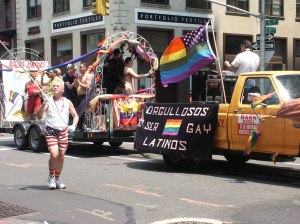
Gay Latinos

In any case, CNN claims that straight Latinos are finally catching on and becoming ever so tolerant. The article points out that “El Diario La Prensa, one of the oldest and largest Spanish-language newspapers in the U.S., recently endorsed the rights of same-sex couples to marry.” And it goes on to say that “while harassment in schools for Latino gay students remains high… these students have more support than in past generations.”

So maybe someday it won’t just be white, upper-class teens with hip parents who get to come out. Maybe the tortured, conflicted Pedros of America will finally be able to explain to their parents why they’d rather design a spring ensemble than work on the low-rider.

Of course, the CNN article loses credibility for me because they laud Perez Hilton as a role model. I mean, what could be more ridiculous that praising a blogger?


Division of Labor

When my wife and I relocated to the West Coast, the moving company that we hired sent a middle-aged white man to perform the estimate and sell us on his organization. He wore a tie and laughed a lot, even when nothing was particularly funny.

The actual movers were four Latinos. They did not wear ties.

The chief of the crew spoke perfect English, but his three assistants communicated with each other in a dialect so thick (deep Central America is my guess) that I barely recognized it as Spanish.

Although they had the far more important (and substantially more grueling, miserable, and labor-intensive) job, their take-home pay could not have approached that of the laughing man in the tie, despite our cash tip and the Coke Zeroes that we supplied to them.

At one point, they carried boxes piled high, Sherpa style, with the weight pressing on their spines. They seemed embarrassed to ask for water, and went about their jobs with a focus that I’ve rarely witnessed in the white-collar world.

movingmen

Now, I certainly don’t want to get into the whole plight-of-the-proletariat aesthetic. Nor do I want to glamorize their hardscrabble existence in some kind of Steinbeckian ode to the nobility of the working class. For all I know, they’re assholes.

In truth, as movers, they kind of sucked. They were hours late both picking up our stuff and dropping it off at our new place. I can only presume that they are afflicted with Hispanic time (that’s the subject of a whole other post).

More disturbing, there was enough damage to our stuff that we had to file a claim for reimbursement. The scratches, dents, and outright destruction that they wrought upon our possessions were, I believe, direct consequences of the Latino work ethic (I’ll explain what I mean by that in yet another post later).

In any case, my original point is that in an ideal society, these exhausting and humbling jobs would be performed by teenagers of all social classes – kids who are at the height of their physical powers and can arguably be said to be “building character” (although I despise that term). Such jobs would not be done by tired guys just trying to eke by, with little hope of ever going further in life. These men are not going to take anything away from the experience except muscle aches.

Will their children follow in their footsteps and sign on for a lifetime of backbreaking manual labor? Or will they take advantage of their parents’ decision to come to America, and someday be the ones to sit back, negotiate with customers, and laugh and laugh?


Garage Sale

The lawn mower went for twenty bucks…

Because of our recent cross-country excursion, my wife and I needed to get rid of every item that had no bearing on our new life (eg, we don’t need a snow shovel in a Los Angeles apartment) or that wasn’t absolutely vital or that didn’t bring us enormous quantities of joy. So a couple of weeks before we left, we held our first moving sale.

The end table went for ten dollars…

It was liberating to dispose of so much junk that had cluttered our lives. And the cash was nice, although when we figured out how many hours we poured into the effort, we figure that we made minimum wage. Perhaps it’s a question for the “Freakonomics” guys: Does anyone actually make decent money having a garage sale?

garage-sale-season

My neighbor carted off the entertainment center…

In any case, the biggest surprise of the weekend was the makeup of our customers. I had assumed that most of the people who frequented rummage sales were old women eager to interact with strangers or suburban guys looking for good deals on power tools or middle-class people who think it’s fun to haggle. Indeed, many of those types of people showed up.

The Asian tea set went to a pre-adolescent boy who was either shopping for his mother or is gay…

However, among the first people to saunter onto our lawn that warm Saturday morning was a quiet Latino who milled about for a moment before asking how much the microwave oven was. It was clear that his English was fledgling, so I had to call upon my piss-poor Spanish to make the sale. He seemed delighted at the everything-must-go price.

Minutes later, a car pulled up, and several men spilled out. They were clearly trabadorjes, and they spoke excitedly about the power vac and the ladder and the box of bungee cords. To pay for their acres of items, they presented me with a crisp hundred-dollar bill. Obviously, they had just been paid, in cash under the table, and our moving sale was their Home Depot and Target and Tiffany’s. They culminated the transaction by buying one of my guitars, which I assumed would offer them some entertainment in their shared tiny apartment.

My ex-boss took the fake Christmas tree…

Throughout the day, more of my Hispanic brethren showed up. Latinas looking for costume jewelry and little girls enamored with baubles for a quarter and burly men who bought three t-shirts for a dollar – they poured over our discards eagerly. All seemed thrilled with our approach to pricing.

And I don’t know whether I was happy that we could help people who were obviously short on cash, or saddened that whole families of Hispanics had to resort to yard sales to fulfill basic needs.

The pooper scooper went for a buck…

My wife and I didn’t have the sale as a backdoor to charity. But that’s what it felt like at times. And the recipients were people who looked like me, but who were still trying to figure out how to achieve the privileged position of getting rid of all this junk rather than buying it.

The last things to go were a pair of folding chairs that a middle-aged Latino lugged to his car. After that, the sun began to set, and my wife and I carted the rejects inside, where they would sit until we donated them to someone who really needed them.


The New Neighborhood

So I’ve arrived at my new place in Los Angeles. As such, I hope to get back to regular blog updates soon, although for the time being, my top priority will be digging us out of the heap of boxes that overwhelm our home.

The whirlwind experience of finding an apartment featured myriad phone calls and frantic acceleration through the streets of LA, with the always pleasant task of flying across the country thrown in there for bonus stress points.

I had gone so long between airplane trips that I had forgotten how fun it is to be “randomly” selected for an extra pat-down by the TSA. Perhaps I should have explained that I’m Hispanic and not (as they clearly assumed) Middle Eastern. But this would have implied that I agree with right-wing zealots that there’s something inherently wrong about being Middle Eastern. And in any case, it wouldn’t have made a difference to those on perpetual watch for the next Mohamed Atta. I do think it was a bit excessive, however, to wand me while I was buckled in my seat on the airplane. But I was assured that this is standard procedure.

tsa-search

In any case, my wife and I are happy with our new home. Because we live in a neighborhood in which I spent little time during my first stint in LA, I did some research online to discover what I’m getting into. I found out that some famous past residents of my new hood include Anais Nin, Tom Waits, and Kiefer Sutherland – all of whom I’m sure had nicer digs than our humble abode.

But something disturbed me when I performed my due diligence. According to reputable online sources, the neighborhood in which I now live has a high percentage of Latinos. Even more alarming, it is also home to, as one source put it, “numerous creative types.”

I’m at a loss at how I got into this situation. I mean, surrounded by both Latinos and “creative types”… surely those two demographics will be the death of America.

How will I survive with my values intact?


We Have Ignition

If all goes according to plan, the Space Shuttle Discovery will lift off this Friday morning. Two Hispanic astronauts – Jose Hernandez and Danny Olivas – will be aboard, marking the first time that multiple Latinos will be on the same shuttle.

I imagine it drives racists insane. Not only are Hispanics spreading out beyond their home countries and inner-city barrios, now they’re taking off into outer space.

Watch it, there’s no place where Latinos aren’t poised to take over!

shuttle-launch---800x6001

In any case, much of the media attention has been fixed on Hernandez rather than Olivas. There’s a good reason for this. Hernandez has an amazing life story: As a child, he worked in the fields with his immigrant parents and didn’t even learn English until he was twelve. When he was a teenager, Hernandez read about NASA’s first Hispanic astronaut (a man with the truly cool name of Franklin Chang-Diaz). Thus inspired, Hernandez applied himself and moved beyond a lifetime of manual labor.

And now, he and Olivas will become two of the few Latinos to ever work in zero gravity. It’s a compelling saga, and I now look forward to hearing about the first Latino on Mars.

By the way, “First Latino on Mars” would be a great name for my autobiography. I’ll just have to make clear that I’m speaking metaphorically.


No, I Don't Got It

A few months ago, I was caught up in the Facebook craze of “25 Random Things About Me.” Before you judge, let me point out that at least I’m holding out on joining “Mafia Wars.”

In any case, one of my random facts was the revelation that getting milk on my skin creeps me out. This is what I wrote:

“The sensation and smell of milk on my skin is one of the most repulsive things in the world to me. Whenever I handle the liquid, which isn’t often, I treat it like explosive nitroglycerin.”

GlassMilk

My squeamishness toward milk is not, I believe, related to the fact that I’m lactose intolerant. If it were, most of the people in my family – and indeed, most Hispanics – would share my revulsion at the liquid. I’ve heard Asians have similar problems. And it’s not uncommon among African Americans.

In fact, pretty much the only individuals who are really designed for the substance are of European (specifically Scandinavian) descent. This seems to surprise many people.

The myth that milk is good for everybody was propagated by those ubiquitous “Got Milk?” ads, which I don’t believe featured a single Hispanic. This was not due to the nefarious racism of the dairy industry. Rather, it was the simple acknowledgement that, once past childhood, most Latinos have to watch their intake of ice cream, mac-n-cheese, and the like. Failure to do so can lead to, shall we say, explosive results.

It was comical growing up lactose intolerant in America’s Dairyland. It’s like living in Vegas and hating gambling, or moving to Cooperstown and despising baseball. Perhaps the realization that my physical condition was an instant metaphor helped me to develop my love of bitter irony.

Speaking of ironic (or just as random as the original twenty-five Facebook facts), I have to point out that I love cheese. It may be my favorite food.

What’s that all about?


Back in Black

We often measure a group’s cultural power by that most base of indicators, the theoretical root of all evil itself: Money.

By that gauge, Hispanics lag far behind the majority culture. However, as befits the largest ethnic-minority group (and the fastest-growing demographic) in America, Latinos are a growing economic powerhouse. In terms of consumer spending, we actually have more clout than African Americans do.

Still, as I’ve written before, black Americans are more likely than Hispanics are to have their shit together (politically speaking). That’s why movements such as the Empowerment Experiment get going.

This project is the brainchild of African Americans who aim to help black-owned businesses thrive. People who join the Empowerment Experiment agree that for a year, and to the best of their ability, they will patronize only African American merchants.

As you can imagine, it’s not easy to bypass white-owned businesses. There are also legitimate questions about the ultimate motivation behind this idea.

Is it a display of cultural pride, and a helping hand to struggling entrepreneurs who are often overlooked, especially in these economically dismal times? Or is this, as some critics put it, “ethnic cheerleading” and possibly even reverse racism?

A slew of angry conservatives say, “There would be outrage if a movement developed to make sure that people shopped only at white-owned businesses.”

No, that would just be the verbalization of a normal business day. Sticking to white-owned businesses would be the easiest principled stance of all time, like declaring that from now on, I will breath only air that has oxygen in it.

So let’s say that the Empowerment Experiment is a well-meaning project that leaves an icky aftertaste, dependent as it is upon picking companies based on the owners’ ethnicity.

From a Latino perspective, the issue becomes “Should we copy this strategy?” Is it a good idea for Latinos to patronize only Hispanic-owned businesses?

Well, adopting this plan creates a few logistical problems. For starters, although it may be easy to find a great place to eat (Mexican restaurants, El Salvadoran pupuserias, etc), buying goods and services beyond that would quickly become a challenge for even the most dedicated Latino.

This fact relates to deeper issues. I’ve written before about the insecurity complex, or outright jealousy, that Hispanics often feel with regards to our African American brethren. The Empowerment Experiment is another reminder of how we’re not quite up to their level of influence. In most of the country, we don’t have as many entrepreneurs, doctors, lawyers, and so on to propel such a movement – hence the envy.

But the flip side is that Latinos are less likely to push for such a development in the first place. Despite the prevalence of ethnic barrios (which I’ve written about before), many Hispanics want nothing more than to fit into the majority culture and to be accepted. This can sometimes take the form of self-loathing or ingratiating behavior.

But for the most part, we simply want others to know that we are part of U.S. culture. Any Latino who has ever been told, “You look American” knows what I’m talking about. Even illegal immigrants want their contributions to the American story to be told.

We do not have the security of pointing out that many of us are new to the country. We don’t want to offer an opening to those who claim we don’t belong here, and saying that we’re only going to shop at certain establishments does exactly that.

African Americans have four hundred years of residency in the United States – most of it, of course, spent as second-class citizens or much worse. But after generations of setting down roots, building families, and influencing the culture, even the most virulent racist would have a hard time saying that blacks are not authentic Americans.

Latinos do not have that sense of hard-won security, not yet at least.


  • Calendar

    September 2026
    M T W T F S S
     123456
    78910111213
    14151617181920
    21222324252627
    282930  
  • Share this Blog

    Bookmark and Share
  • My Books

  • Barrio Imbroglio

  • The Bridge to Pandemonium

  • Zombie President

  • Feed the Monster Alphabet Soup

  • The Hispanic Fanatic

  • Copyright © 1996-2010 Hispanic Fanatic. All rights reserved.
    Theme by ACM | Powered by WordPress