Culture

Microcosm

In his bestselling book, Thomas Frank asked the immortal question, “What’s the matter with Kansas?”

As someone who has spent time there I can answer, “A lot.” (Just kidding, all my Kansas friends; go Jayhawks!).

In any case, this story about one Kansas county, and the Hispanics who live there, recently caught my attention. There are so many elements at play in this one tale that I’m devoting a whole post to hyperanalyzing it.

First, the story points out that Finney County (population: 40,998) has just turned majority-minority. This means that over half the residents of this fine heartland community are not white (there is also a large Asian population present). Finney County thus joins the ten percent of U.S. counties to have this distinction – and yes, the number is growing. The gist of the story is that this change is happening in (gasps all around) the middle of the country, and is not just contained to wacky California and big old rambling Texas.

I’ve written before about the changing demographics of America, and what this means for the future. Whole books have been, and no doubt will be, written about what the United States will look like in the future, when the name Rodriguez is considered just as all-American as O’Malley. But it’s worth noting this fresh proof out of Kansas that the process is underway and irreversible.

Also, the article casually mentions that Hispanics have lived in Finney County for “more than 100 years.” This gives some context to the vitriol that Latinos are suddenly swarming into America and undermining traditional values. Sorry, but it’s clear that Hispanics have, for decades now, helped build the country, and this process is only accelerating.

Speaking of that, the fabled Latino work ethic makes an appearance in the story. As I’ve stated before, it’s not always an intrinsically good thing that Hispanics often labor like demons.

In fact, we don’t have to read far into the article before encountering the words “massive meatpacking plants,” which is a phrase inherent in any story about growing Latino populations in small towns. Is it really such a great thing that the shit jobs go to Hispanics, who are only too willing to take them because of their strong drive to work, work, work?

meatpacking300

This relates to another topic I’ve touched upon in these posts: the antipathy that too many Hispanics feel toward education. One reason for this is the intense focus placed upon work, especially of the manual type. In fact, one Hispanic resident says that many of his fellow Latinos “tell their kids they don’t need to go to college because this is a good life.” Let’s be blunt: Asian and Indian immigrants don’t say things like that to their kids, and it shows.

Finally, the article touches upon the changes that occur and the tensions that arise when the culture shifts. Or as the article breathlessly states, “This Midwest enclave, home to hamburgers and hot dogs, is giving way to… Mexican tacos.”

Let’s set aside the fact that plenty of Hispanics like hamburgers and hot dogs (I myself am partial to bratwurst, but that’s another story). How are some of the white inhabitants of Finney County adjusting? Well, one resident says, “There were always whispers. Out at Wal-Mart, you hear, ‘Oh, look at how they’re dressed… wonder where they’re from, what they’re doing here?’ Especially if they weren’t speaking English.”

What’s funny is that, apparently, some of the longtime residents of the county don’t appreciate the cliché of an exotically dressed person jabbering away in a crazy language. So their solution is to become an even bigger cliché by whispering, “What are they doing here?” in the Wal-Mart aisle. I can only hope that they spit out a wad of tobacco before adding, “Damn foreigners are taking over!”

But it’s not all angry glares in town, veiled animosity on the street, and awkward moments at the superstore. Another resident says that it’s “nice to have those different cultures.” Another advises to offer “open arms to people that come in your community because they might be the person that’s going to help you when you have times of struggle.”

That same resident says that everyone should “just try to be a good person” to others, regardless of their differences.

His comments amaze me. Who let that radical in?


Play Ball!

Let me give a quick thanks to Macon D and Xey for their comments on my last post (“A Latino Rodney King”). They agreed with my conclusion, which is great. But let me also thank Turtle, who disagreed with me. It’s good to get a free flow of ideas going.

But because the last couple of posts have been so serious, I’d like to lighten up with his one.

Like millions of other American males, I love baseball. It is the only sport I follow religiously, and it is one of the few topics that I feel comfortable talking about at length without fear of coming across as ignorant (deluded and opinionated perhaps, but not wholly unknowledgeable).

So I’m thrilled that the season has started again. My team is above .500, and their efforts should be a cause for alternating bouts of joy, frustration, disbelief, and relief for the next five months or so.

Perhaps my fondness for this most pastoral of games has a cultural basis. As you may know, baseball is incredibly popular in Latin America, trailing only soccer. But I’m convinced that a lot of the enthusiasm for that foot-based sport is glee over the announcers yelling, “Gooooal!,” which is more entertaining than the games.

More likely, my appreciation for baseball is because of its inherent, tension-ratcheting drama (the very aspect that critics mislabel as “boring.”) And I’ve always been fascinated with its history, which has often served as a metaphor for America itself. For an obvious example, look no farther than the great Jackie Robinson for an instant analysis of racial relations.

As such, it’s disappointing that Hispanics are shut out when it comes to one aspect of the game. That’s right, the whole controversy over team nicknames has excluded us.

Native Americans can get up in arms over the Atlanta Braves or Cleveland Indians. But Latinos are unlikely to protest the San Diego Padres. It’s just not the same.

In fact, the whole issue of offensive names has a distinctly Native American flair to it. There have been arguments about various collegiate Fighting Sioux teams, and overt hostility toward the NFL’s Washington Redskins (a moniker so pejorative that I can’t see how it’s even open to debate).

But what do we Hispanics have? The UC-Santa Barbara Gauchos are unlikely to incur our wrath. Similarly, we just aren’t going to lose our minds if anybody decides to call themselves “The Amigos,” which would be the least terrifying team name ever.

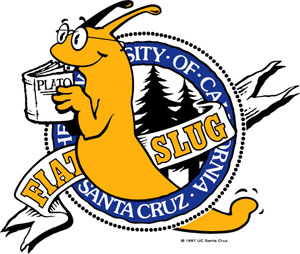
On second thought, that honor probably rests with the UC-Santa Cruz Fighting Banana Slugs:

bluegoldblack400

Yes, it can be difficult to be left out of a racial/ethnic controversy, but I guess we’re just going to have to let this one pass. So I say, good luck to those Native Americans who are fighting the good cultural fight. Latinos can offer you no more than moral support.

Let me add, however, that I’m part Irish. As such, I’m offended that Notre Dame has chosen some brawling, drunken leprechaun as its mascot…

No, I’m just trying too hard now. Forget it.


Cough Cough

Thanks to Betty for her generous comments on my last post (“The Horror, The Horror”). She’s correct that the “The Fog” is worth watching again and again.

Thanks also, of sorts, to Eva. I believe that she meant to comment my recent post “Mi Casa Es Su Casa…” but she posted to the wrong topic. However, I’ve decided to leave her remarks under the “About the Author” section for the time being, if for no other reason than people can see that I’m not being paranoid when I assert that Latinos are being blamed for the housing crises. Most interesting was Eva’s assertion that as soon as the Hispanics in her area were foreclosed upon, “the sun began to shine again.” This verifies what I’ve thought all along: Latinos can control the weather.

Speaking of Latino-centric disasters, by now you’ve no doubt heard about the killer flu that originated in Mexico. Dozens of people are dead in that country, and cases have sprung up in the United States. In all likelihood, this virus – an offshoot of swine flu – will run its course long before the country turns into something out of Stephen King’s “The Stand.” Just in case, however, I suggest you check out that sore throat that’s been bothering you.

The flu outbreak has forced me to tack on an unpleasant addendum to my recent post about hugging. As I stated in that piece, Latinos love to hug, and warm embraces of even casual acquaintances are frequent in Hispanic culture. As such, it must have come as a shock to the Mexican populace that, in addition to fearing for their lives, they are being told to avoid hugging and that there should be “no kissing to say hello” and “no close contact” with others.

That’s right – the Latino impulse to embrace people may help to spread the virus. As such, good Hispanics everywhere must abruptly turn into Swedes and Norwegians, out of the fear that a quick squeeze of a friend could lead to an unpleasant death for everyone involved.

Of course, being forced to limit physical interaction is psychologically upsetting to people of any culture, but even more so for Latinos. As one Mexican woman said, “Mexico is a social place. People like to go out and be together. The sickness has taken that away.”

And it’s also taken away, at least temporarily, the Latino drive to be affectionate and demonstrative. That means no hugging, my amigos.

The most disturbing thing about this epidemic – aside from the inconvenient potential it has to cause whole civilizations to collapse – is that it has turned what we always viewed as a virtue into a detriment.

Latinos now have to wonder if maybe those Scandinavians, with their virus-killing cold weather and contagion-limiting handshakes, are on to something after all.

Mexico Swine Flu


The Horror, The Horror

First off, thanks to Quickbeam and Allegra for their thoughtful comments on my last post (“Believe”). I appreciate their faith, in every sense of the word.

Now, my previous post may have given people the impression that I base everything upon logic, and disdain the supernatural or unexplainable. That’s not true, of course, because I love a good ghost story.

I just don’t love them as much as my mom does.

For proof, let me regale you with the time that my mother and I got into an argument at the video store. It was the mid- 1980s, and the selection was sparse in those pioneering days of the VCR. Still, it was probably a little odd to see me, a sullen teenager, arguing to rent “Raging Bull” while my mother insisted on getting “The Omen 3.”

You see, my mother, about whom I’ve written before, has very definite ideas about what constitutes fine cinema. By her criteria, a great film must include at least one of the following elements:

  • A car chase with the monstrous villain in hot pursuit
  • An unstoppable killer robot/android/cyborg
  • A hidden door leading to a hellish parallel dimension
  • A good-looking vampire
  • A winged demon ripping people’s souls out through their chests

These are pretty great standards, of course, and I have no issue with them. But at one point, I thought they were a little too restrictive. Could a great movie also feature subtle character development, dramatic perspectives on another era, or startling insight into the human condition?

Well, my mother would point out that such factors only slow down the movie and delay getting to the really good part where that slimy alien creature devours the lead astronaut’s head.

In a way, she’s correct.

Horror movies have been unfairly maligned as empty, moronic time-wasters – the creepy third cousin at the cinematic family reunion. Even mainstream comedies get more respect.

But films of this genre are often the cultural barometer of where we stand. In addition, they can serve as a cathartic release for our fears and pain. This may especially be true for those of us who have witnessed violence or suffered through the abrupt departure of loved ones, like my mother has.

The history of Latin America, in truth, has been one long horror movie for some time. I don’t know if Hispanics are more likely to embrace scary movies, but I wouldn’t be surprised if this were true.

For example, one of my friends, a man who is originally from my family’s home country of El Salvador, has a vast treasure trove of horror movies. His wife, born and raised in America, tolerates his fascination and puts up with the overflowing boxes of tapes and discs, all of which offer some kind of gruesome imagery.

With so much real-life horror in our backgrounds, we seem well-suited to fictional depictions of terror. Perhaps this is why my mother constantly overrode my fledgling attempts at film snobbery when I was younger.

More than once, she would arrive home from a hard day of work to announce that she had stopped at the video store on the commute. Then she would enthusiastically proclaim, “I picked up the ‘Seven Doors of Death’!”

But let me be clear. She actually has good taste, singling out classics like “Rosemary’s Baby” and contemporary masterpieces like “The Descent” for high praise. She dismisses substandard fare with a direct “That is not scary” – the ultimate insult for a horror film.

Maybe because I grew up on them, or because I’m Latino, or because movies like “The Others” are so damn cool, I still love these kinds of films. Our joint appreciation for terrifying spectacles is one of the things my mother and I have in common.

For this reason, I have never understood my friends who say they don’t know what to do for entertainment when their parents visit. When my mom drops by to see my wife and me, we can always just pop in a DVD of “The Thing.”


Prepare for Impact

It wasn’t happy hour. It was more like unhappy hour, and it was held at a bar near my former place of employment. At the end of this going-away party for all of us who had just been downsized (see my earlier post on this), the time came to say goodbye to my former colleagues, make sincere but doomed promises to stay in touch, and exchange final hugs.

Actually, I pretty much had to skip that last one.

You see, I live in the Midwest, and most of my ex-coworkers are born-and-bred white middle Americans. As such, they are as comfortable with the idea of hugging as China is with dissent.

One of my friends, a woman I had worked with for years, announced beforehand that she rarely hugged her family members and never her friends, so I would have to settle for a handshake. Her preemptive strike was because she knew my propensity to embrace people.

It’s not that I’m touchy-feely. Indeed, I’ve been accused of being reserved, aloof, and even insensitive. On any given personality test, I always come back as introverted and quiet (not shy; there’s a difference). Bubbly and outgoing are among the last adjectives one would use to describe me.

So where does all this hugging come from? You guessed it: the Latino gene.

Hispanics hug out of instinct. We hug loved ones and acquaintances. We hug when saying hello or goodbye. We hug when overjoyed and when offering condolences. And yes, we will even hug you.

The cultural reasons for this are unknown to me. But it’s a very real phenomenon. Suffice to say, we’re perplexed at white America’s reticence and (I’ll just say it) uptight attitude about being touched.

This can lead to painful interactions, which I have witnessed at times, where the white person sticks out a hand, and the Hispanic person looks at it as if mystified at what to do with the offending object. Depending on the relationship and the setting, you may as well spit in a Latino’s face if a handshake is the best you can offer.

Even my wife, of fine German-Irish stock, was thrown off by my tendency to wrap my arms around people. I hugged her once when we were still in the “just friends” stage of our relationship, and she figured I was up to something… ok, she was right about that one. But that’s not usually the case.

The point is that my wife, who is extroverted and expressive, was confused by my behavior. These days, of course, she reciprocates the bone-crushing clasps that my family dishes out as greetings. It’s what we do.

And on a larger level, and at the risk of getting all New Agey, isn’t this the exact right time to hug? With a collapsing economy and nonstop wars going on, I would think more Americans would appreciate a comforting embrace.

But in fact, just the opposite is true. Over the last few years, for example, several public schools have tried to ban hugging among students. It’s supposedly to decrease the odds of a physical confrontation. The irony, of course, is that a hug is the least threatening gesture that one can make. Such policies are clearly more about America’s sex-phobia and the discomfort that adults feel whenever they see teenagers touching each other. But that’s another post.

What it all means is that at some point, every American has to decide if he or she is going to follow the example of Hispanics (who, as I’ve stated many times before, are clearly taking over the country) or withdraw into a cold world where the nearest one gets to being touched is receiving an extra emoticon on the latest text message.

In any case, if you’re meeting a Latino for the first time, remember that we’re ok with a handshake for the initial encounter. After that, however, it has to be a business meeting or similarly inappropriate setting to keep us from wrapping you up.

Either that, or we really don’t like you. 


The Winter of My Discontent

Spring is officially here. It arrived at 8:44 am (CST) on March 20.

But for those of us who live in this snowy Northern city that I call home, winter may not end for another month, when we’ll finally venture outside sans parkas for the first time in a half-year or so.

As I’ve mentioned before, when I was a kid growing up in the Midwest, I was among the few Latinos in a sea of husky blonde children with German and Scandinavian last names. Their ancestors had become impervious to the cold. Indeed, they developed a bizarre affection and even love for the arctic blasts and bone-chilling frost and icy pain that their homelands offered. And they brought this sick predilection with them when they emigrated to America, often passing it along to their children.

This was not the case with my ancestors. They came from tropical climates where people only felt chilled if they had developed some horrific disease brought on by rainforest insects chomping on them. Otherwise, it was constantly sweltering, and they built up little immunity for the chest-bursting cold that is so common in my home state.

My ancestors rarely experienced anything below freezing, while I consider such temperatures to be a comfortable day. And yet I live here by choice. Perhaps it’s all been an elaborate hoax.

I believe that I was scammed as a child into thinking that the climate isn’t so bad. I heard the constant refrain of older citizens (usually the aforementioned ninth-generation Germans and Scandinavians) that the harsh weather “builds character.”

Perhaps there is some truth to this. My time living in sunny California convinced me that people who grow up in gorgeous environments often become pampered, shallow adults. Then again, it’s LA I’m talking about, so perhaps it’s not the best control group.

But even if it is true that the bitter cold “builds character,” let’s be clear about one thing: At a certain point in the winter, and definitely at a certain point in one’s life, you’ve gained all the character you ever will through subzero wind chills. The rest is just punishment or the delusion that we like this or the futile hope that we will become better people because of it. There is little, if any Zen insight to be gained from shoveling snow. In fact, that shoveling is more likely to provoke a heart attack than conjure “character.”

So maybe I’ve never fully adapted to the cold. Maybe it takes more than a few dozen winters to be at peace with the ice and snow.

But then I think of the remarkable determination and resiliency that Latinos have shown over the generations. Certainly, we can adapt to any conditions, persevere over any situation, and succeed in any environment.

Yes, all that is true.

But it’s also true that winter really fucking sucks.


Best in Show

My wife and I are geeky enough to watch dog shows on Animal Planet. Go ahead and pass judgment, but if last month’s Westminster winner, Stump the Sussex Spaniel, didn’t charm you on some basic level, I’m not sure that we can be friends. 

bestinshow0211091

It seems like many of the handlers at dog shows are Latino. Certainly many more of them are Hispanic than black or Asian. For me to even notice this means that it’s, well… noticeable.

I’m not sure why Latino handlers are so ubiquitous. I’d like to think that it’s because Hispanics have a strong bond to the animal kingdom and a healthy respect for nature. That’s nice to think, especially as I hear about dogs running wild in the streets of Latin America and the Amazonian rainforest being slashed and burned.

Certainly, it’s not a cultural thing. I can’t imagine a less likely goal for a kid growing up in the barrio than to hope that someday he can escort a Pomeranian in Madison Square Garden.

My best guess is that this oddly specific “sport” is for all those Hispanics with a competitive streak who aren’t interested in baseball. There are few other sporting outlets for us, after all.

For the most part, we’re not big enough for football or tall enough for basketball. And as for hockey… well, let’s just say that ice-focused endeavors face an uphill climb in Latino culture. Soccer is big in Latin America, of course, but in the United States it appears to be the strict dominion of pre-adolescent suburban girls.

So if you’re a Latino who can’t hit the slider, but still want to win at something, it seems to come down to golf, tennis, or dog shows. I’m not sure which of those I would pick, but I understand the appeal of the latter. There’s no sweat involved, and your teammate will always have your back.


Cold Case

As a rule, I don’t follow news stories that contain any of the following elements:

  • Celebrity misbehavior
  • Fashion do’s and don’ts
  • Golf
  • Young, pretty white women who go missing

I have to make an exception to this last category, however, by mentioning the Chandra Levy case. There are two reasons for this.

First, I have an odd personal connection to the incident. No, I never met the woman. But I vividly remember the day that she disappeared, in early 2001.

I was living in Los Angeles, and my wife and I had dinner plans with a co-worker who I thought might become a friend. But I clearly didn’t know him well.

The guy, henceforth called Crazy Eddie, was an acquaintance of Chandra Levy. But one would have thought that they were Siamese Twins by how much he played up the closeness of their relationship. Over dinner, he talked of nothing else but her disappearance, and he did so in a freeform, rambling manner that overwhelmed my wife and me.

I soon realized that what I had thought were Crazy Eddie’s good qualities at our job (ie, unlimited energy, passion for his work, extreme attention to detail) were actually the symptoms of a cackling mania. The guy couldn’t shut up, and he hatched conspiracy theories and metaphorical meanings and personal reflections that all centered on Levy’s disappearance, then swirled around each other and overlapped until none of us could figure out his original point.

It was, understandably, the only time my wife and I socialized with Crazy Eddie, and we vowed to never again dine with a madman. The last time I spoke to him, shortly before I left LA, he tried to enlist me in his scheme to fly to Washington DC and investigate Levy’s disappearance personally. He insisted that, with my help, he could find out what happened to her. I politely declined and then fled the state.

The second reason I’m thinking of Chandra Levy these days is because police apparently cracked the case last week. The alleged murderer is… yes, Latino… in fact, he’s an immigrant… from El Salvador, my family’s homeland… fuck.

This creepy guilt-by-association feeling is what I wrote about in a previous post. We have enough cultural baggage to carry without some moronic thug fulfilling stereotypes faster than Bill O’Reilly can spew them.

It is, of course, completely selfish to dwell on what this means to me and other Hispanics. But seriously, of all the imbecilic criminals to become national news, did it have to be the Salvadoran immigrant rapist-murderer?

In any case, I’m glad that Chandra Levy’s friends and family can find some comfort that her killer has been nabbed. But I have to wonder if, somewhere in LA, my old friend Crazy Eddie is babbling in his apartment, desperate to find a new outlet for his amazing powers of insight.


We Love to Love You

In honor of Valentine’s Day, I want to give a shout out to all those Latin Lovers… Actually, let me stop there. What the hell is a Latin Lover anyway?

Whenever I hear the phrase, which has actually been pointed at me a couple of times, I think of some confident guy who charms roomfuls of women but regularly loses tracks of how many ladies he’s slept with that week. This is not me, by the way.

Other images come to mind. Is it the guy who snaps his heels together, plays flamenco guitar, and presents blushing ladies with roses? Or is it the player who flashes devilish smiles, tells oily lies to naïve women, and dumps trusting females eight seconds after ravishing them? Or is the guy who is open and expressive, has a sensitive-artist vibe, and respects women as well as lusts after them?

All of these images have, at one time or another, been presented. By the way, other Latino male archtypes – such as the uber-macho hombre, the mama’s boy, and the barrio thug, among many others – don’t traditionally fit the category of Latino Lover. So let’s leave them alone, for now.

Of course, there is also a female version of the Latin Lover. These are usually exotic beauties who beguile (what a great verb!) respectable, rational men. The guys are helpless in her presence, even though she inevitably is either poor, crazy, or up to no good – probably all three.

Regardless of gender, the Latin Lover is usually presented as, at best, a fling of simple passion. They really don’t have any emotional states beyond getting aroused and flying into jealous rages, and as such, they’re poor choices for long-term companionship.

In worst-case scenarios, the Latin Lover is an obstacle to the hero or heroine’s true love. Under such circumstances, the confused woman or blinded man eventually returns to his/her stable partner, kicking the lothario to the curb or ditching the dark-skinned mistress.

Like every other aspect of our culture, Hollywood has had an influence in shaping the iconography. After the imbroglio caused by my previous posts about Hispanic representation in the movies, I don’t want to get too much into it. Suffice to say that the original Latin Lover was probably Rudolf Valentino, the silent-film star who terrified/fascinated innocent waifs in the early days of cinema.

But Valentino was Italian, which leads to a question: How strict is the “latin” part of that equation? After all, we’ve seen many people of different ethnicities play this role – everyone from Antonio Banderas (a Spaniard) to Selma Hayek (a Mexican) to Johnny Depp (a white guy).

So perhaps being a Latin Lover is more a state of mind than an ethnic identity. Still, its roots in ethnicity cannot be ignored. And this leads to larger questions.

For starters, is the image of the Latin Lover a stereotype? If so, is the modern definition confined to Hispanics, or as we have seen, can Italian or Greek or even hot white people be Latin Lovers?

Furthermore, if it is a stereotype of Hispanics, is it a positive or negative one? Or is the concept of a positive stereotype an absurd oxymoron? Really, how insulting is it – if it’s derogatory at all – to be called a Latin Lover?

As I mentioned in one of my first posts, my future mother-in-law, upon finding out that her daughter was dating a Hispanic guy, famously said, “Those Latins. They love ya, then they leave ya.” I should point out that my wife and I will soon celebrate our 18th anniversary. So I guess I’m not much of a Latin Lover, at least not according to my mother-in-law’s definition.

So let me ask a final set of questions. Are you a Latin Lover? Are you involved with one? And in either case, is that a good or bad thing?


The Doctor Is In

I’m a little late on this news item, but it’s worth noting.

The University of Texas System has picked Francisco Cigarroa, a transplant surgeon, to be their new chancellor. He becomes the first Hispanic to lead a large public university system in America.

I say congrats to Dr. Cigarroa. It’s always good to erase the phrase “no Latino has ever” from discussions of leadership and accomplishment. The man even had to accept a pay cut to take the job, so he must really want to do it.

Perhaps his appointment is some sort of karmic balancing act that offsets the withdrawal of Bill Richardson (aka, the most famous Latino leader) from Obama’s cabinet. By the way, I’m still not sure what Richardson did that was so egregious, but the convoluted nature of his offense indicates that it was more politically stupid than actively criminal.

In any case, Cigarroa’s new gig represents a milestone for Hispanic leadership. But it is also more than that. The doctor’s quote upon taking the job was telling.

“I believe education is the equalizer of all mankind,” Cigarroa said. “The fact that I am blessed by being Hispanic carries an important responsibility for being a mentor and role model.”

First off, I like the reference that one is “blessed by being Hispanic.” It doesn’t always feel that way.

More important, however, is Cigarroa’s subtle acknowledgement that part of his job is to push Hispanics to take advantage of education’s power. Latinos have lagged behind other groups when it comes to graduation rates, test scores, and advanced degrees. There are several reasons for this, ranging from the travails of immigrant life to overt racism (sorry people, it still exists).

But I’ve always believed that the chief culprit is self-created. The lack of respect, sometimes bordering on disdain, that education receives in Latino culture is alarming. I’ve written about this before, and no doubt will again.

I doubt that one person’s appointment will change the attitude of those Hispanic parents who simply don’t emphasize the importance of education to their kids. But at least one educator recognizes how vital it is. And it helps that he was once one of those kids and knows what he’s talking about.


  • Calendar

    September 2026
    M T W T F S S
     123456
    78910111213
    14151617181920
    21222324252627
    282930  
  • Share this Blog

    Bookmark and Share
  • My Books

  • Barrio Imbroglio

  • The Bridge to Pandemonium

  • Zombie President

  • Feed the Monster Alphabet Soup

  • The Hispanic Fanatic

  • Copyright © 1996-2010 Hispanic Fanatic. All rights reserved.
    Theme by ACM | Powered by WordPress